

How Christian peacemaking ministries handle mandatory reporting laws is not a peripheral compliance matter. It sits at the intersection of pastoral care, civil authority, trauma stewardship, and a donor’s obligation to fund work that protects the vulnerable without betraying the trust that makes confession and reconciliation possible.
The tension is real: peacemaking ministries are often invited into situations that include domestic violence, child abuse, sexual assault, coercive control, and threats of self-harm or harm to others. Scripture calls the church to gentleness and restoration, but it also demands that we “give justice to the weak and the fatherless” (Psalm 82:3). A ministry that cannot describe, in verifiable terms, how it fulfills both obligations is asking donors to underwrite risk with little accountability.
Mandatory reporting is a ministry reality, not a legal footnote
Most Christian conflict resolution work begins with a promise: we will listen carefully, keep faith with the parties, and pursue truth with patience. Mandatory reporting introduces a second promise: when specific harms are disclosed, the ministry may be legally required to notify civil authorities, even if doing so disrupts mediation or counseling.
Christians genuinely disagree about how these obligations should be framed inside church life. Yet Romans 13 does not permit a blanket dismissal of civil authority, and Matthew 18 does not authorize secrecy that perpetuates harm. The question is not whether reporting laws exist; it is whether the ministry has built a disciplined practice that honors both the vulnerable and the law.
Why donors should treat reporting practices as a safeguarding test
Conflict resolution ministries often work with asymmetric power. One party may be a spouse with financial control, a leader with spiritual authority, or an adult against a child. In those contexts, “neutrality” can become a moral error. Well-designed mandatory reporting practices are one of the clearest signals that a ministry understands power, risk, and the limits of mediation.
The basic legal landscape is more complex than many assume
Mandatory reporting duties vary by state and by role. Some states require all adults to report suspected child abuse; others limit the duty to designated professionals. Clergy-penitent privilege exists in many jurisdictions but differs widely in scope, and it may or may not cover para-church mediators, lay counselors, or “biblical counselors” depending on how the ministry operates. The most responsible ministries obtain state-specific legal counsel and train staff accordingly rather than relying on generalized assumptions. For a high-level map of state child welfare reporting resources, donors can begin with the federal Child Welfare Information Gateway at Child Welfare Information Gateway.

Where reporting duties collide with confidentiality and pastoral trust
Peacemaking work depends on honest disclosure. If participants believe they will be reported for every painful detail, they may conceal precisely the information that indicates danger. If participants believe nothing will ever be reported, a ministry may become an unwitting shelter for ongoing abuse. The most mature ministries confront this collision directly in their intake process.
Clear informed consent is a theological and ethical obligation
Informed consent is often treated as legal self-protection. In Christian ministry, it is also a matter of truthfulness. “We refuse to practice cunning or to tamper with God’s word, but by the open statement of the truth we would commend ourselves to everyone’s conscience” (2 Corinthians 4:2). A ministry should explain, before substantive conversation begins, what confidentiality means, what it does not mean, and what triggers a report.
Across our verification work at Most Trusted, ministries that meet The Most Trusted Standard tend to document this clearly: written acknowledgments, plain-language summaries, and consistent verbal reiteration, especially when topics shift into higher-risk territory.
Do not confuse mediation confidentiality with legal privilege
Some donors assume “confidential mediation” functions like attorney-client privilege. In most ministry settings it does not. Even where certain communications may be protected, mandatory reporting statutes can create affirmative duties that override expectations of privacy, particularly concerning child abuse. Ministries that speak carefully about the limits of privilege are usually ministries that have sought competent counsel and have built internal safeguards rather than relying on rhetoric.

What sound policy looks like in practice
A credible mandatory reporting posture is not a single paragraph in a handbook. It is a set of decisions embedded into hiring, training, supervision, documentation, and partnerships with local authorities. The ministries that handle this well generally aim for two outcomes: (1) timely reports when required, and (2) minimized harm in the reporting process through coordination, care, and survivor-centered support.
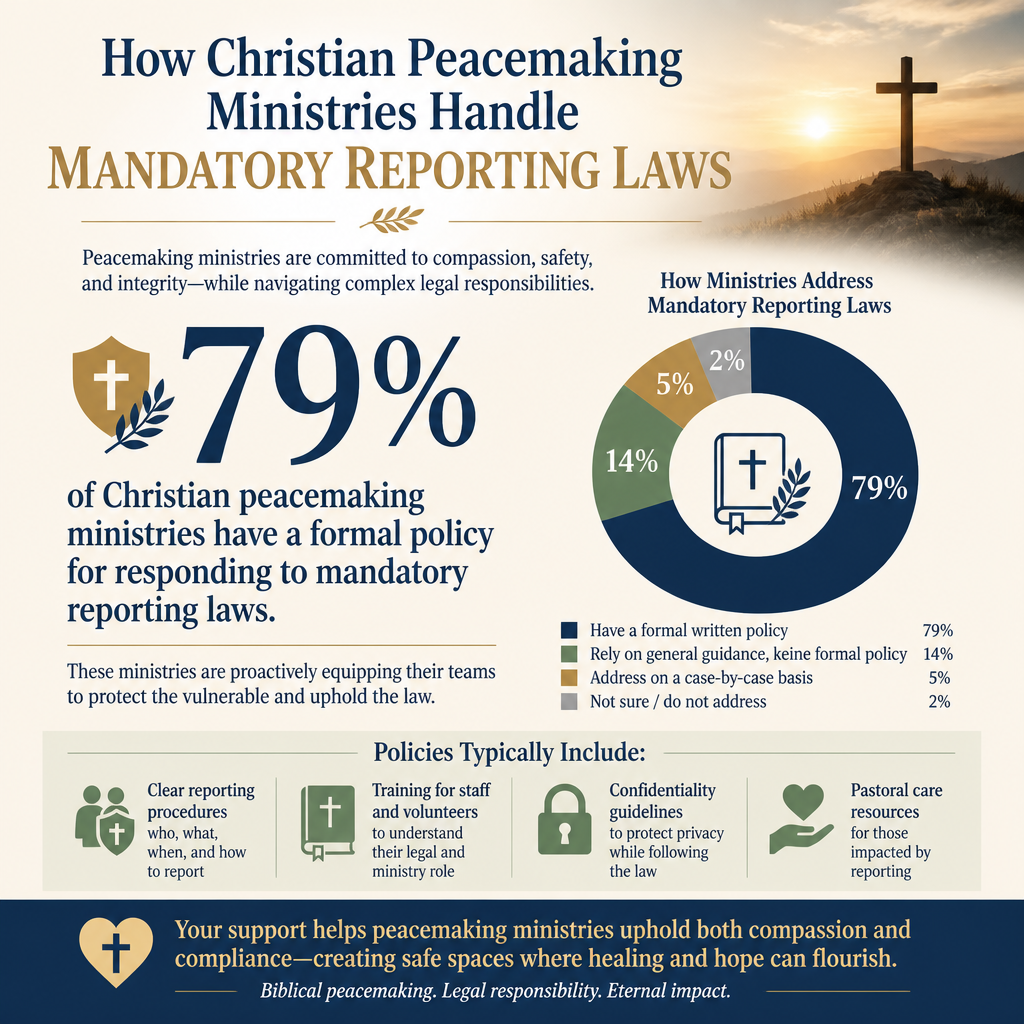
Policy elements donors should expect to see
Donors do not need to be attorneys to ask concrete questions. The following markers are both practical and morally serious, and a mature ministry can answer them without defensiveness:
- Written, state-specific reporting procedures that identify who reports, how, and within what timeline.
- Role clarity on who is a mandated reporter within the organization, including volunteers and contractors.
- Documented training cadence, including onboarding and annual refreshers with scenario-based practice.
- A supervision pathway for uncertainty, including access to qualified legal counsel and clinical consultation when relevant.
- A survivor-support plan that addresses safety planning, referrals, and pastoral care after a report is made.
Documentation should protect people, not merely institutions
Documentation is often where ministries either mature or unravel. If notes are sloppy, emotionally loaded, or inconsistent, they can harm victims and mislead investigators. If notes are overly detailed, they can expose survivors and minors to unnecessary risk if records are subpoenaed or leaked. Wise practice typically includes disciplined, minimal-necessary recordkeeping; secure storage; defined retention schedules; and restricted access. The objective is not secrecy. The objective is stewardship of sensitive information for the sake of those who are already vulnerable.
Special cases that can derail peacemaking efforts
Mandatory reporting questions rarely arrive in neat categories. They arrive in partial disclosures, ambiguous timelines, and competing narratives. The harder question is not whether a ministry cares about justice; it is whether the ministry has the competence to recognize high-risk dynamics and act accordingly, even when doing so makes reconciliation more difficult or slower.
Domestic violence is not ordinary marital conflict
Many Christian donors have seen sincere reconciliation language used to pressure victims back into unsafe situations. Domestic violence includes patterns of coercive control, intimidation, and isolation, not merely anger or poor communication. Where abuse is present, joint mediation can increase danger, and “both sides” frameworks can obscure responsibility. While mandatory reporting laws for adult domestic violence vary, a ministry that treats domestic violence as a standard peacemaking case is signaling a lack of safeguarding maturity.
For donors seeking a baseline of how the field defines domestic violence and coercive control, the National Domestic Violence Hotline provides widely used definitions and safety resources.
Child abuse and grooming indicators require heightened discipline
Child abuse disclosures often come indirectly: a child’s comment, a parent’s euphemism, or a leader’s attempt to “handle it internally.” The moral danger for ministries is delay. Reporting statutes commonly require prompt action when there is reasonable suspicion, not certainty. Ministries that understand this train staff to identify grooming patterns, to avoid interviewing children in ways that contaminate testimony, and to prioritize immediate safety over reputational concerns.
Donors should also be alert to structural conflicts of interest. If a peacemaking ministry is hired by a church or institution to “keep the matter quiet,” that funding arrangement can pressure the ministry away from reporting and toward containment. The most credible ministries insist, in writing, that safeguarding duties are non-negotiable and cannot be contracted away.
How donors can evaluate ministries with confidence
Christian donors are not funding an abstract ideal. They are funding people, processes, and institutional habits. Verifiable evidence suggests that ministries most likely to mishandle mandatory reporting are those with unclear authority lines, weak governance, and informal counseling models that outpace training. This is one reason Most Trusted evaluates ministries against The Most Trusted Standard across faith commitments, governance, financial integrity, and transparency.
Questions that reveal whether a ministry is prepared
Responsible ministries will not answer these questions with slogans. They will answer with policies, training records, and clear boundaries:
- Who inside your organization is trained and authorized to make a report, and how is coverage handled after hours?
- How do you communicate reporting limits to participants before sensitive disclosures occur?
- What is your protocol when allegations involve church leadership, major donors, or board members?
- How do you coordinate with law enforcement or child protective services without compromising survivor safety?
- What do you do when reporting is not legally required but serious harm is credible and imminent?
Where to place this in a broader due diligence framework
Mandatory reporting practice should be weighed alongside governance and transparency. A ministry may have heartfelt theological commitments but lack operational discipline. Donors should not mistake warmth for readiness. Accountability structures, independent board oversight, documented safeguarding policies, and a demonstrated willingness to refer cases to specialized professionals are the kinds of institutional signals that reduce risk over time.
For donors tracking the wider ecosystem in which these ministries operate, Christian Conflict Resolution Ministries provides helpful context on common models and their strengths and limits.
Within that ecosystem, legal and ethical maturity deserves distinct attention, because it is often where harm is either prevented or multiplied. The category Legal and Ethical Standards in Christian Conflict Resolution captures many of the issues donors should treat as non-negotiable when funding peacemaking work.
FAQs for How Christian peacemaking ministries handle mandatory reporting laws
Do mandatory reporting laws override confidentiality in Christian counseling or mediation?
In many jurisdictions, yes, at least in defined circumstances such as suspected child abuse. The scope depends on state law and on the role of the person receiving the disclosure. Mature ministries explain these limits clearly in writing and verbally at intake, and they obtain state-specific legal counsel rather than relying on generalized claims about “confidentiality.”
Should donors avoid supporting peacemaking ministries because reporting can disrupt reconciliation?
No. Reporting can disrupt a mediation process, but the alternative can be far worse: the preservation of apparent peace at the expense of the vulnerable. Scripture’s call to reconciliation does not nullify the call to justice and protection. Donors should support ministries that treat reporting as part of faithful safeguarding, with policies, training, and survivor-centered care that reduce harm when civil involvement becomes necessary.
Funding peacemaking that protects the vulnerable
Christian peacemaking is not sentimental. It is a disciplined pursuit of truth, repentance, restitution, and, where possible, restored relationship. Mandatory reporting laws force ministries to clarify whether their first loyalty is to a process or to the protection of those at risk. Donors should fund ministries whose policies and governance show that they understand this test and have chosen, consistently and verifiably, to “do justice, love mercy, and walk humbly with your God” (Micah 6:8).



