

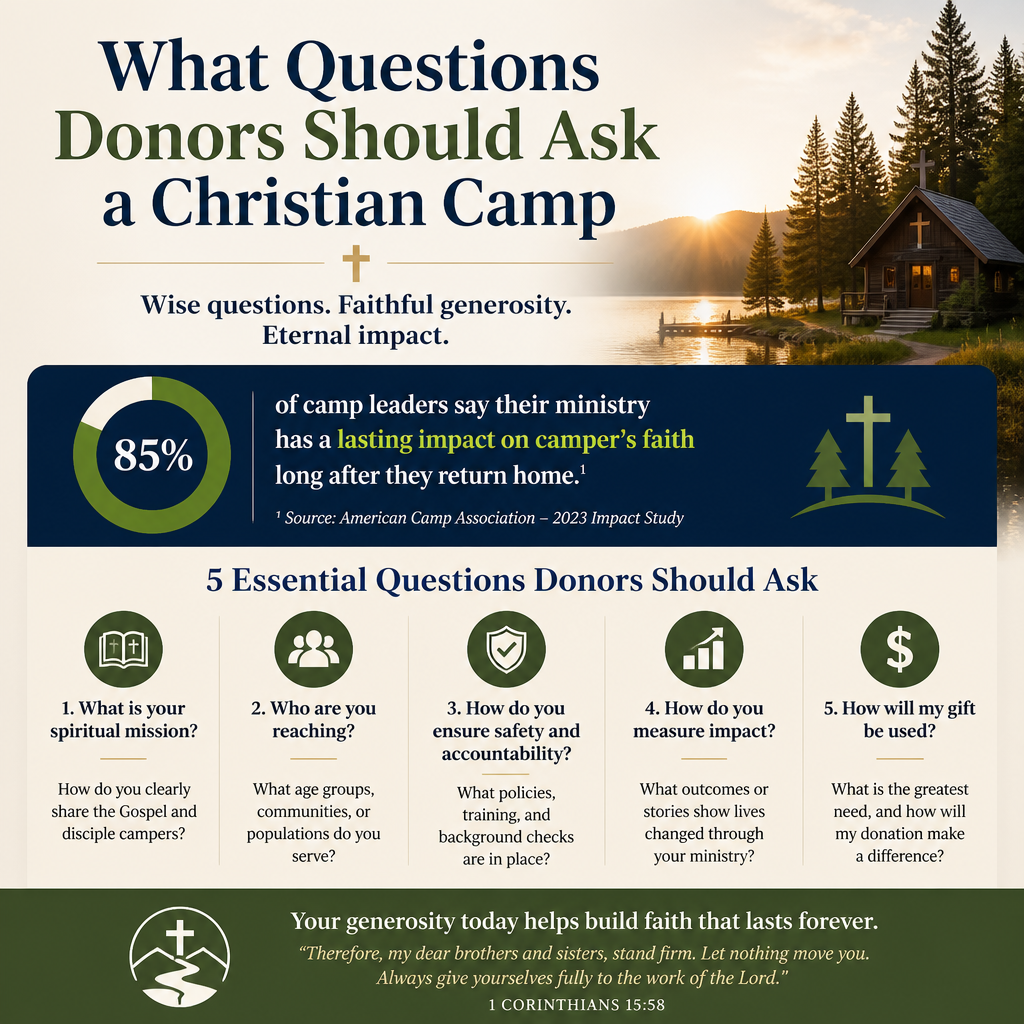
The questions donors should ask a Christian camp are not merely administrative. They are spiritual and fiduciary questions about whether a ministry’s formation claims are credible, whether its safeguarding is rigorous, and whether its stewardship honors the Lord who sees in secret. Christian donors are not buying a weekend experience; we are underwriting discipleship, trust, and often a child’s first sustained exposure to Christian community.
Summer camp has a long and fruitful history in American evangelicalism, and many adults can point to camp as a decisive moment of repentance, calling, or spiritual renewal. The harder truth is that “camp fruit” can be difficult to discern from emotional intensity, and camps can be tempted to market outcomes they cannot honestly measure. Mature giving asks questions that are fair, specific, and verifiable.
1. Begin with theology and formation, not programming
What is the camp forming, and by what means
A Christian camp can run an excellent program and still be unclear about what it is trying to form. Donors should ask for the camp’s doctrinal commitments, statement of faith, and discipleship philosophy, then probe how those convictions shape the camp schedule, teaching content, and counselor training. A camp that says “we want kids to follow Jesus” should be able to explain what following Jesus looks like at age nine, fourteen, and seventeen, and how the ministry avoids mistaking short-term emotion for long-term discipleship.
We recommend asking who writes and reviews curriculum, what theological tradition guides the teaching, and how the camp handles secondary differences among Christians. A camp serving a broad constituency should be candid about where it has firm convictions and where it practices charity. That kind of clarity reduces the risk of doctrinal drift while also preventing unnecessary division.
How is the local church honored rather than replaced
Healthy camps generally understand themselves as a servant to the local church, not a substitute for it. Donors should ask how the camp partners with pastors and parents, how it follows up after camp, and whether it encourages campers toward baptism, membership, and ordinary means of grace in their home congregations. A camp can tell moving stories and still be isolated from meaningful ecclesial accountability.
Across our verification work at Most Trusted, ministries that meet The Most Trusted Standard tend to articulate a clear relationship to the local church and to treat spiritual influence over minors as a trust that must be stewarded with theological humility.
2. Test governance and accountability as seriously as you test vision
Who holds leadership accountable when no one is watching
Christian camps often combine high relational intensity with seasonal staffing and remote locations, which can create real governance vulnerabilities. Donors should ask who governs the organization, how the board is selected, and how conflicts of interest are disclosed and managed. If a camp is effectively controlled by one family or a small inner circle, donors should ask what independent oversight exists when hard decisions arise.
Request basic governance documents that serious nonprofits routinely provide: board roster, leadership bios, conflict-of-interest policy, and a summary of how the organization evaluates executive performance. These are not hostile requests. They are part of treating a Christian ministry as something more than a charismatic vision.
What is the camp’s posture toward transparency
Camps are sometimes reluctant to share financial and governance information, especially if they are small. Yet donors can ask a simple question that reveals a great deal: “What information do you proactively publish for supporters, and what do you share when asked?” A ministry that is committed to walking in the light should not treat basic accountability as an intrusion.
For donors who want a broader view of how camps fit into the ministry landscape, we maintain editorial coverage of Christian Camps and Conferences that reflects recurring strengths and recurring risks in this sector.
3. Put child safety and spiritual power dynamics at the center
Safeguarding is more than background checks
Donors should ask direct questions about safeguarding policies, reporting pathways, and training. Background checks matter, but they are not a full child protection program. A credible camp will describe staff-to-camper ratios, two-adult rules, rules about private communication, supervision in cabins and bathrooms, transportation policies, and how it handles overnight scenarios. It should also be clear about how it screens and supervises seasonal staff, who may be young and inexperienced.
The U.S. Department of Justice notes that most child sexual abuse is committed by someone the child knows, not a stranger, which underscores why internal controls and supervision matter as much as screening (Office of Justice Programs).
How does the camp handle disclosure, discipline, and repentance
Christian camps are entrusted with children who may disclose abuse, self-harm, suicidal ideation, or family instability. Donors should ask what training staff receive on mandated reporting and crisis response, how the camp partners with local authorities and professional counselors, and what happens when a staff member violates policy. A camp that speaks eloquently about grace must still have a sober, well-documented discipline process. Repentance does not erase consequences, and forgiveness does not require placing a child at risk.
We recommend asking whether the camp has an external reporting option, whether it documents incidents, and whether it can describe past situations in anonymized form that demonstrate follow-through. The point is not to demand perfection; it is to see whether leadership has prepared for predictable realities rather than hoping they never occur.
4. Follow the money with biblical stewardship and financial rigor
What does it cost to run camp, and what do donors truly subsidize
Donors routinely underwrite scholarships, facilities, and staffing. Those are worthy aims, but camps should be able to explain their unit economics in plain language: cost per camper week, what fees cover, what philanthropy covers, and what reserves exist for deferred maintenance and emergencies. When camps postpone maintenance or operate without adequate reserves, scholarship dollars can unintentionally prop up an unsustainable model.
Many donors have heard simplistic claims about overhead. The more responsible approach is to ask whether spending aligns with mission and whether the organization can demonstrate appropriate internal controls. The “Overhead Myth” statement signed by major evaluators argued that overhead ratios alone do not measure effectiveness and can distort donor decision-making (BBB Wise Giving Alliance).
Scholarships and designated gifts deserve special clarity
If the camp solicits scholarship funds, donors should ask how scholarship need is assessed, whether the camp verifies financial hardship, and how it avoids incentives that could unintentionally pressure families. Some camps use a simple “pay what you can” model; others use church referrals or documented need. Each can be legitimate, but the camp should be explicit about its method and consistent in applying it.
We recommend asking these questions in a single, direct sequence:
- How many campers receive scholarships each season, and what is the typical award size?
- How do you define and verify financial need?
- Are scholarship dollars restricted to camper tuition, or can they be used for travel, gear, or staffing?
- What happens if designated scholarship funds exceed need in a given season?
- Do you report back to donors with aggregate results while protecting camper privacy?
Donors should also ask whether the camp issues audited financial statements, reviewed statements, or internal statements, and who prepares them. Smaller camps may not afford an audit, but they should still have competent bookkeeping, segregation of duties, and board-level financial oversight.
5. Ask for evidence of spiritual and programmatic effectiveness
What outcomes can be claimed with integrity
Camps frequently highlight decisions for Christ, rededications, and worship experiences. Those moments can be real. Yet donors should ask how the camp understands spiritual fruit over time and what it can responsibly measure. Scripture warns against confusing appearances with reality; “the LORD sees not as man sees” (1 Samuel 16:7). A camp should be careful not to market certainty where only hope is warranted.
Reasonable indicators might include parent feedback, church leader feedback, repeat attendance patterns, counselor retention, and post-camp engagement in local congregations where partnerships exist. None of these are perfect, but a camp that refuses any evaluative discipline is asking donors to fund a narrative rather than a ministry.
Are staff and counselors being formed, not just deployed
Many camps rely heavily on young counselors. Donors should ask what theological and pastoral training counselors receive, how the camp supervises them, and what spiritual and emotional support exists for staff who are carrying the burdens of children. A camp that burns through staff, tolerates moral laxity, or treats counseling as “warm bodies in cabins” is a camp with a discipleship problem, not merely an HR problem.
Donors who are especially focused on scholarship programs will often find deeper treatment of these issues within How Christian Camp Scholarships Work, including the practical tensions camps face when they try to widen access without weakening safeguards or sustainability.
FAQs for What questions donors should ask a Christian camp
Should donors prioritize scholarships or general operating support for a Christian camp?
Both can be faithful. Scholarships directly expand access for families who could not otherwise attend, but general operating support often strengthens safeguarding, staff training, and maintenance that makes scholarships meaningful in the first place. We recommend asking the camp where the binding constraint is: unmet scholarship need, staffing capacity, or infrastructure. Then give in a way that addresses the constraint rather than the most emotionally resonant line item.
What if a camp is small and cannot provide audits, outcome reports, or extensive documentation?
Scale is a real constraint, and small camps can be deeply faithful. The key question is whether leadership demonstrates proportional accountability: clear policies, board oversight, transparent financial statements prepared competently, and a willingness to answer reasonable donor questions. A small camp does not need glossy reporting, but it should be able to show that it takes stewardship and child safety with the seriousness they deserve.
A faithful donor posture toward Christian camps
Christian camps can be instruments of grace, and donors rightly want more children to hear the gospel, experience Christian community, and encounter Scripture in a concentrated setting. The questions donors should ask a Christian camp are meant to protect that hope from sentimentality and from preventable harm. When a camp can answer with clarity about theology, governance, safeguarding, finances, and outcomes, it invites giving that is both warmhearted and well-governed, the kind of stewardship Scripture commends.



