

What financial statements Christian conferences should share is not a question of public relations. It is a question of stewardship, and of whether donors can exercise faithful discernment when they underwrite a gathering that carries Christ’s name. Conferences operate at the intersection of ministry and event production, which means real costs, real risk, and real opportunity for misuse if governance is weak.
Scripture treats money as spiritual matter. Jesus’ warnings about treasure, and Paul’s insistence on honorable administration of gifts, do not romanticize religious work; they call it to sober accountability. Donors are not asking for perfection. They are asking for verifiable evidence that leaders handle sacred resources in ways that are consistent with the gospel they proclaim.
Start with statements that show the whole conference economy
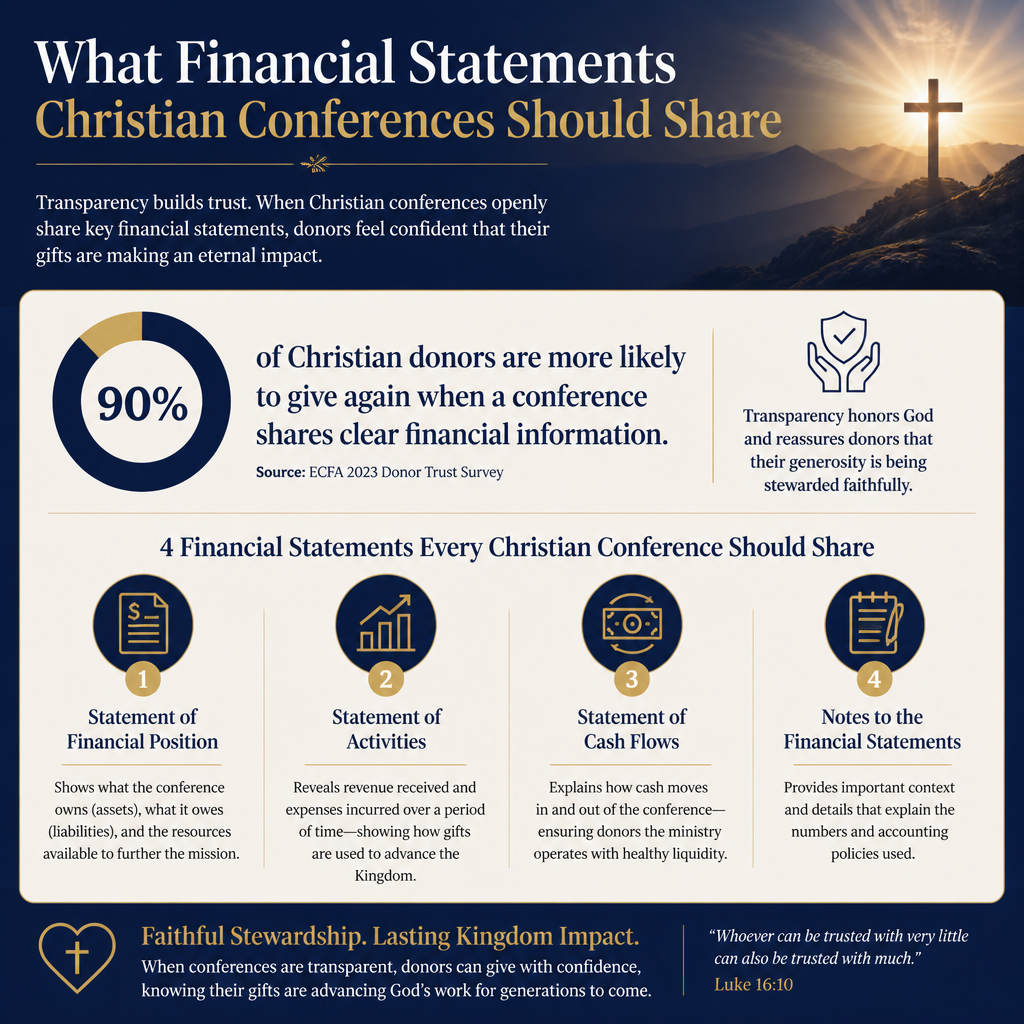
Statement of activities and statement of financial position
A Christian conference should begin with the same core financial statements expected of any mature ministry: a statement of activities and a statement of financial position. The statement of activities shows revenue and expenses over a period; the statement of financial position shows what the conference owns and owes at a point in time. Together they answer basic donor questions: Is the ministry solvent, or is it funding this year’s event with next year’s money? Is it accumulating cash reserves prudently, or masking deficits with short-term borrowing?
For many conferences, the most spiritually significant financial distortions occur when an event “breaks even” only because restricted gifts quietly cover losses, or because related-party support is not clearly disclosed. A statement of activities that separates unrestricted and restricted activity helps donors see whether the conference is sustainable on its own terms or dependent on fragile subsidies.
Statement of cash flows for seasonal realities
Conferences are often seasonal businesses with uneven cash cycles. The statement of cash flows is therefore not optional if a donor wants to understand operational health. It clarifies whether cash is generated by actual operations or by financing activities such as drawing on a line of credit. When a conference insists it is “healthy” while stretching payables or leaning on debt each year, the cash flow statement usually tells the truth more plainly than any narrative update.
Across our verification work at Most Trusted, ministries that meet The Most Trusted Standard tend to publish financials that allow donors to see both accrual results and cash realities. That is not a preference for complexity; it is a preference for honesty in the form the organization actually lives in.

Pair the statements with an audit posture that fits the risk
Audit, review, or compilation is not a technicality
A conference can publish financial statements and still leave donors without meaningful assurance. The level of external accountant involvement matters. An audit provides the highest level of assurance, a review provides limited assurance, and a compilation provides none. A mature conference should disclose which it has obtained and why that level is appropriate given its size, complexity, and risk profile.
The harder question is when a conference says, “We are a ministry, not a corporation,” as a reason to avoid assurance. That posture misunderstands Christian stewardship. If a conference is receiving substantial gifts, processing thousands of registrations, contracting with venues, paying speakers, and managing sponsorship revenue, it has the kind of operational complexity where an audit is often a prudent norm, not a luxury.
Form 990 and public accountability in the American context
For U.S. conferences operating as nonprofits, the IRS Form 990 remains one of the most accessible accountability documents. Donors should not treat it as a spiritual scorecard, but it does provide standardized disclosure on governance, compensation, revenue sources, and major contractors. The IRS requires most tax-exempt organizations to make their three most recent Forms 990 available for public inspection IRS. Conferences that resist sharing their 990 when required are signaling a governance problem before any further analysis begins.
Churches are generally exempt from filing, and some conference entities align themselves with a church structure. Christians genuinely disagree about how much public disclosure should be expected in that setting. Even so, donors can still reasonably expect comparable transparency by other means: audited statements, clear summaries, and board-level oversight practices that are not hidden behind ecclesial language.
Disclose revenue streams that create pressure and temptation
Registration, sponsorship, donor subsidy, and product sales
Conference revenue is rarely a single stream. Registration fees, sponsorships, exhibitor payments, donor subsidies, and content sales each create different incentives. A conference should disclose these categories clearly enough that donors can see what is driving the model. When a conference appears “donor-funded,” but in reality operates as a high-margin event business with minimal charitable dependence, donors deserve to know. When the opposite is true—registration is set below true cost and donors are asked to underwrite the gap—that should be named explicitly rather than implied.
Transparency here is not cynical. It protects the ministry from misaligned expectations. Donors tend to react most strongly when they discover a revenue reality after the fact, especially if it involves corporate sponsorship influence that was not disclosed.
Restrictions, designated gifts, and donor intent
Conferences should also explain how they handle restricted and designated gifts. Donor intent is a moral obligation before it is a legal one. A credible statement of activities will show restricted contributions and how those funds are released or spent over time. The more a conference relies on designated gifts for scholarships, speaker honoraria, or production costs, the more important it is to show donors that restricted funds were not used to plug unrelated deficits.
This is one place where theological language can be misused. Calling a gift “seed” or “prophetic investment” does not remove the organization’s duty to track and deploy funds honestly. Paul’s concern was not merely that funds were spent, but that administration was “honorable…in the sight of the Lord and also in the sight of man” (2 Corinthians 8:21). Donors should expect practices consistent with that twofold accountability.
Clarify expense drivers and governance-sensitive costs
Production, venue, and contractor costs
The largest conference expenses often sit in production, venues, and contracted services. Donors should not assume that high costs are evidence of vanity. A conference serving thousands may need professional staging, security, and technology. Yet because these lines are large, they are also where procurement discipline matters. Publishing expenses in categories that allow donors to see major cost drivers is an integrity practice, not a marketing decision.
For donors trying to understand value, one useful question is whether the conference can describe why major expense decisions were necessary for mission outcomes. A ministry that can speak plainly about costs usually has leaders who can also say “no” when spending becomes self-justifying.
Compensation, honoraria, and related-party transactions
Compensation and speaker honoraria deserve particular clarity. These are not automatically suspect; “the laborer deserves his wages” (1 Timothy 5:18). The concern is governance: whether compensation is set with independent oversight, benchmarked appropriately, and disclosed in a way that does not obscure conflicts of interest.
Conferences should disclose related-party transactions, including payments to organizations owned by insiders, family members, or board members. Even when such arrangements are legal, they require heightened transparency because they create temptation and erode trust when discovered later. Donors are not asking leaders to work for free. They are asking leaders to avoid self-dealing and to submit financial decisions to accountable process.
- High-level expense categories with meaningful descriptions
- Clear disclosure of compensation-setting process
- Speaker and artist payment policies, including who approves exceptions
- Related-party transaction disclosures and conflict-of-interest enforcement
- Scholarship and benevolence funds tracked separately when applicable
Publish documents in a way donors can actually evaluate
Accessibility, timeliness, and plain explanations
Posting a PDF is not the same as being transparent. Financial statements should be accessible on the conference website, easy to locate, and recent. The conference should publish a simple explanation of what the statements cover, what accounting basis is used, and what donors should and should not conclude. Donors often misread financials, especially around overhead ratios; clarity reduces confusion and prevents shallow criticism from driving decision-making.
The nonprofit field has pushed back on simplistic overhead scoring for years. The joint “Overhead Myth” statement by GuideStar (now Candid), Charity Navigator, and the BBB Wise Giving Alliance argues that overhead ratios alone do not measure nonprofit performance and can distort incentives Candid. Conferences should not hide behind that argument to avoid disclosure. They should use it to explain why donors should look at governance, reserves, and outcomes in addition to administrative cost categories.
Connect conference reporting to deeper accountability expectations
Financial statements are necessary but not sufficient. Donors funding Christian conferences also care about doctrinal integrity, governance maturity, safeguarding, and program fruit. That is why we treat financial transparency as one dimension of a broader evaluation under The Most Trusted Standard. The ministries that earn donor confidence over decades tend to give stakeholders a coherent picture: who leads, how decisions are made, how money is handled, and what outcomes are pursued.
For donors who support gatherings as part of broader ministry commitments, it is often helpful to situate conference reporting within the wider landscape of Christian Camps and Conferences. Not every conference has the same scale, risk, or funding model, and expectations should be calibrated accordingly without lowering the bar for honesty.
Where donors see recurring concerns—late reporting, missing statements, unclear related-party disclosures—those issues belong in the broader conversation about Accountability and Transparency in Christian Camps and Conferences. Transparency is not a substitute for trustworthiness, but sustained opacity is rarely compatible with faithful stewardship.
FAQs for What financial statements Christian conferences should share
Should a Christian conference publish audited financial statements publicly?
When a conference is large enough to have complex operations, material donor support, or significant contracting and cash handling, public audited statements are a prudent norm. Smaller conferences may not be able to afford an audit every year, but they should still publish basic financial statements and disclose what level of external review they have obtained. The core donor question is whether the assurance posture fits the risk profile and whether leaders are willing to submit financial claims to independent scrutiny.
Is sharing a Form 990 enough to satisfy transparency expectations?
A Form 990 is a helpful baseline for U.S. nonprofits because it standardizes disclosure, but it is not a full substitute for audited statements, clear financial narratives, and governance transparency. The 990 is retrospective, sometimes difficult for donors to interpret, and may not show event-level economics in the detail a conference requires. A conference that treats the 990 as the ceiling rather than the floor is usually communicating compliance, not stewardship.
A donor standard worthy of the name Christian
Christian conferences ask people to gather under the Word of God, to worship, to repent, to learn, and often to give. That spiritual purpose intensifies, rather than relaxes, the obligation to handle money in the light. When conferences share complete financial statements, adopt an assurance posture appropriate to their risk, and disclose the revenue and expense realities that shape incentives, donors can give without suspicion and without naivete. That is not cynicism. It is stewardship practiced in public, for the sake of Christ’s name.



