
Knowing how to verify a Christian camp’s nonprofit status is not administrative fussiness; it is stewardship. Camp is often where the gospel first becomes plausible to a child, and donors rightly want that work supported with integrity rather than sentiment. The same Scripture that calls us to generosity also calls us to discernment: “Beloved, do not believe every spirit, but test the spirits” (1 John 4:1).
Nonprofit status is not a seal of spiritual maturity. It is a legal and governance framework that can either support faithful ministry or obscure poor practice. What donors need is a way to confirm the camp is truly organized as it claims, and then to ask the harder question: whether it is governed and operated in a way that deserves ongoing trust.
1 Start with the legal definition the camp is claiming
Most Christian camps present as 501c3 charities, but not all do
In the United States, many Christian camps operate as 501(c)(3) public charities. Others operate under a church umbrella, as a program of a denomination, or as a for-profit business that still serves churches and offers scholarships. Each structure has different disclosure rules and different implications for donor oversight.
A camp can do real ministry without being a standalone 501(c)(3). But a camp that fundraises from the public while presenting itself as a “nonprofit” should be able to state plainly which legal entity receives gifts, what that entity’s IRS classification is, and whether donations are tax-deductible.
Understand what 501c3 status does and does not guarantee
IRS recognition means the organization has been approved for tax-exempt charitable purposes under federal law. It does not guarantee healthy governance, wise financial management, safe programming, or faithful doctrine. The IRS is not built to assess spiritual integrity or operational excellence. Donors should treat 501(c)(3) status as a threshold question, not the finish line.

2 Confirm the entity through primary sources, not marketing language
Use the IRS Tax Exempt Organization Search to verify status
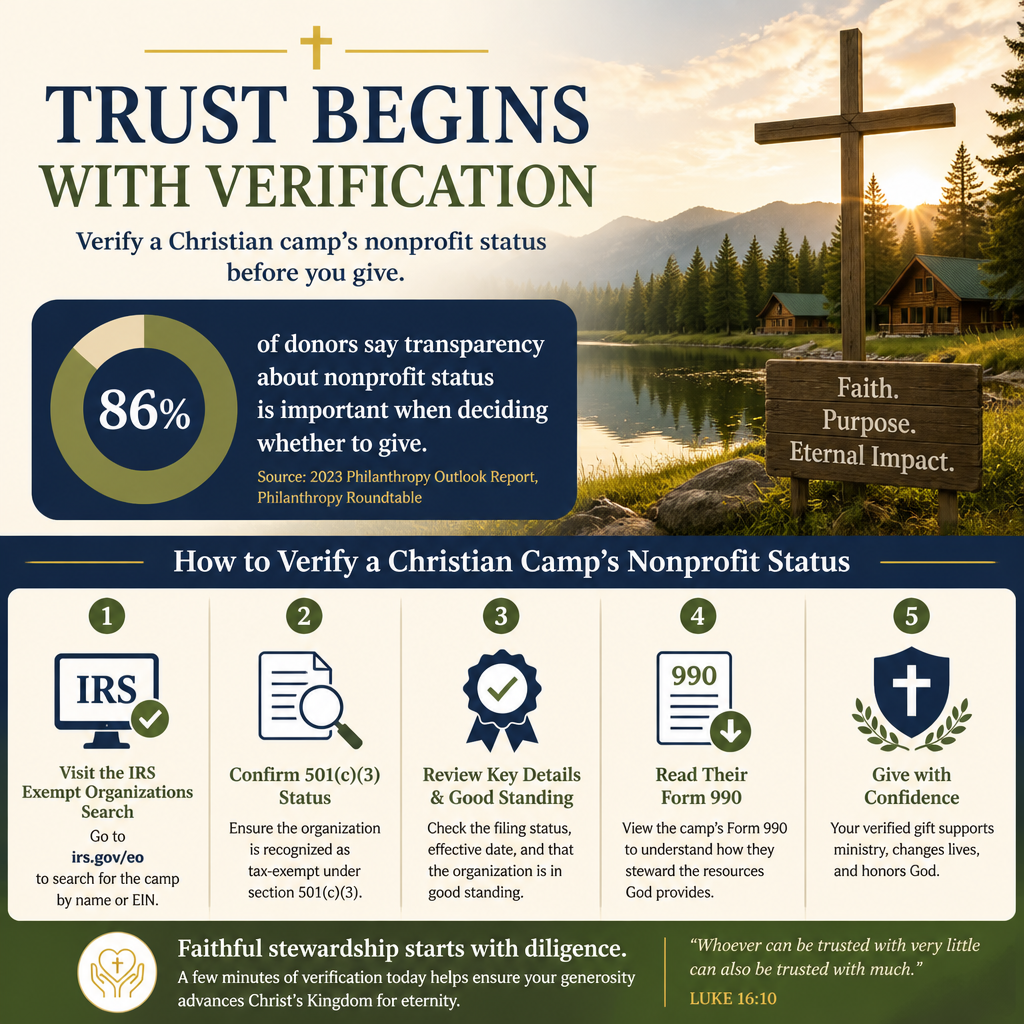
The most direct step is to verify the entity in the IRS database. Search the legal name and, if possible, the Employer Identification Number. You are looking for confirmation that the organization is listed as tax-exempt and that its status has not been revoked.
Use the IRS Tax Exempt Organization Search here: IRS.
Two cautions are worth naming. First, camps sometimes operate under a parent corporation with a different name than the brand used on brochures. Second, if a camp is a ministry of a church, it may not appear in the IRS search tool, because churches are generally not required to apply for 501(c)(3) recognition in the same way as other charities. In those cases, the camp should be able to explain its relationship to the church clearly and in writing.
Cross-check with the organization’s Form 990 or exemption letter
If the camp is a 501(c)(3) that is not a church, it should generally be able to provide either its IRS determination letter or its most recent Form 990. Form 990 is not a spiritual document, but it is a transparency document. It shows legal name, governance structure, key compensation, major programs, and certain related-party transactions. For many donors, it is the single best window into whether the camp treats accountability as normal rather than adversarial.
When you are assessing camps and conferences, it can also help to keep the wider context in view. Our ongoing coverage of Christian Camps and Conferences examines recurring governance and transparency questions across the sector.
3 Verify state registration and public accountability signals
Check state charity registration where applicable
Beyond the IRS, many states regulate charitable solicitation. Requirements vary widely, and religious exemptions can apply. Still, a camp that is actively fundraising across state lines should be prepared to describe where it is registered to solicit contributions. State charity registries are often searchable through the attorney general’s office or secretary of state.
This step matters because it separates organizations that treat compliance as part of moral seriousness from those that treat it as optional. It also helps donors confirm that the legal entity soliciting funds is the same entity that claims nonprofit status.
Use credible nonprofit databases with appropriate caution
Third-party databases can be helpful for locating filings and confirming identifiers, but they should not be treated as final authority. A listing may lag behind IRS updates, and ratings can over-weight simplistic financial ratios. What we want is documentary confirmation, not the comfort of a score.
Practical tools donors often use include:
- IRS Tax Exempt Organization Search for basic status confirmation
- State charity registries for solicitation registration where required
- Form 990 repositories such as GuideStar by Candid: Candid
- The camp’s audited financial statements when audits exist and are shared
- Policies and disclosures published on the camp’s own website
4 Treat nonprofit status as the doorway to deeper due diligence
Governance is often where camps either earn trust or spend it
Camps are relational by nature. Families entrust children. Churches entrust retreats. Donors entrust money intended for the formation of young disciples. That relational trust should be matched by institutional safeguards: a functioning board, clear conflict-of-interest boundaries, and leadership accountability that does not rely on charisma.
Across our verification work at Most Trusted, ministries that meet The Most Trusted Standard tend to treat governance documents as living protections rather than legal formalities. We look for evidence that the board is real and engaged, that related-party transactions are disclosed and controlled, and that leaders do not operate as if the organization belongs to them.
Financial integrity requires more than low overhead
Donors are sometimes trained to treat overhead as the primary test of integrity. The sector has rightly challenged that simplistic assumption. The “Overhead Myth” letter—signed by Charity Navigator, GuideStar, and the BBB Wise Giving Alliance—argues that judging nonprofits primarily by overhead ratios can mislead donors and pressure organizations into under-investing in effectiveness and accountability: GuideStar by Candid.
For camps, the practical questions are concrete: Are restricted gifts honored? Are scholarship funds tracked properly? Are capital projects separated from operating budgets? Is there an independent review or audit appropriate to the organization’s size and complexity? A camp can be financially modest and still careless. It can also be financially sophisticated and still faithful. The aim is not austerity; it is integrity.
5 Ask the questions that reveal whether transparency is a ministry value
What a trustworthy camp can answer without defensiveness
Some camps hesitate to share documents because they fear misinterpretation or because they have never developed the habit of donor-facing transparency. Donors can acknowledge that complexity while still insisting on clarity. A ministry that handles children, employs staff, and solicits charitable gifts should not treat basic disclosure as hostile.
These questions tend to separate credible organizations from fragile ones:
- What is the legal name and EIN of the entity receiving donations?
- Are gifts tax-deductible, and under which classification?
- Who sits on the board, and how are conflicts of interest handled?
- Can you share the most recent Form 990 and key policies?
- How do you report outcomes beyond attendance numbers?
Transparency and effectiveness belong together
Christian donors are sometimes told that asking for evidence signals a lack of faith. Scripture suggests the opposite: faithful stewardship is careful, not credulous. Jesus’ teaching about money is consistently moral and practical, and the early church managed shared resources with public integrity (Acts 6:1–6).
Effectiveness in a camp setting is not always reducible to metrics, and Christians genuinely disagree about what should count as “impact.” Some emphasize conversions; others emphasize discipleship habits, leadership development, or long-term church attachment. A trustworthy camp will name its aims plainly, avoid inflated claims, and report candidly on what it is learning.
For donors who want to evaluate camps through a consistent accountability lens, our work in Accountability and Transparency in Christian Camps and Conferences addresses the disclosures and governance practices that tend to correlate with durable trust.
FAQs for How to verify a Christian camp’s nonprofit status
What if the camp says it is a ministry of a church and does not have a Form 990?
That can be legitimate. Churches are generally not required to file Form 990, and a camp operating as a program of a church may not file separately. Donors should ask for written clarification of the relationship, confirm the church’s legal identity, and request alternative documents that demonstrate accountability, such as a budget summary approved by the church’s governing body, policies for child safety and background checks, and a clear statement of how designated gifts are tracked and honored.
Is an EIN enough to prove the camp is a nonprofit?
No. An EIN is an identifier used for tax administration; it does not, by itself, prove 501(c)(3) recognition. The verification step is to match the EIN and legal name to IRS tax-exempt status in the IRS Tax Exempt Organization Search and then confirm the entity’s filings and governance disclosures align with what the camp claims publicly.
A stewardship practice that honors both generosity and truth
When donors verify a camp’s nonprofit status, they are not substituting bureaucracy for faith. They are aligning giving with truth, resisting avoidable deception, and encouraging ministries to operate in the light. Nonprofit status can be confirmed in minutes, but the deeper work is to support camps whose governance, financial integrity, and transparency are consistent with the gospel they proclaim.



