
Funding Christian camp facilities and capital needs is rarely about bricks and mortar alone. For Christian donors, it is a stewardship question: whether a place can remain safe, hospitable, and mission-fit for the next decade of gospel ministry, or whether deferred maintenance will quietly erode both excellence and integrity.
Christian camps sit at an unusual intersection of discipleship, youth development, hospitality operations, and risk management. A dining hall is also a ministry room. A bunkhouse is also a child-protection environment. A waterfront is also a regulated safety system. The harder question for donors is not whether facilities matter; it is how to fund them without rewarding poor planning, masking weak governance, or subsidizing a perpetual crisis cycle.
Capital funding is discipleship funding when it is tied to mission clarity
Scripture does not treat physical resources as spiritually neutral. Jesus regularly pressed money back into the realm of worship and obedience, and the early church treated material provision as a concrete expression of love and unity (Acts 4:32–35). For camps, a capital project becomes spiritually meaningful when it protects the integrity of ministry outcomes: children and families experiencing Christian community, hearing Scripture taught faithfully, and encountering models of embodied service.
At the same time, Christians genuinely disagree about the line between necessary investment and unnecessary expansion. Some donors prefer funding program staff and scholarships, fearing that buildings signal institutional self-importance. Others see facilities as the precondition for sustainable ministry capacity. Both instincts can be faithful. What matters is whether the camp can demonstrate that the facility request is disciplined by mission and accountability rather than driven by prestige or panic.
Mission-fit beats novelty
Across our verification work at Most Trusted, the camps and conference ministries that meet The Most Trusted Standard tend to describe capital needs in operational and pastoral language rather than in marketing language. They can explain how a renovation improves safety, accessibility, child protection, staff sustainability, or the learning environment for Scripture engagement. They can also name what the project will not do: it will not become a revenue-chasing venture that distorts programming, and it will not pull attention away from discipleship priorities.
Donors can ask for a simple “mission-fit statement” from leadership: one page linking the capital scope to ministry aims, participant experience, and measurable constraints (season length, staff capacity, program mix). The absence of that statement does not prove wrongdoing, but it often signals that the project is being shaped by enthusiasm more than by strategy.
Capital is often a child protection question
Facility condition directly touches camp safety: egress, fire suppression, lighting, supervision sightlines, bathroom privacy, and the basic ability to separate age groups and genders responsibly. Donors should expect leadership to speak candidly about risk management. If a camp is unwilling to discuss safety standards, incident reporting practices, or child protection policies, a new building is not the core problem.
Maintenance is part of truth-telling
Christian organizations do not honor the Lord by hiding liabilities. Deferred maintenance can become a form of institutional denial: roofs patched indefinitely, HVAC systems limping along, cabins used past design life, and staff improvising around hazards. Responsible camps surface these realities early and price them honestly.
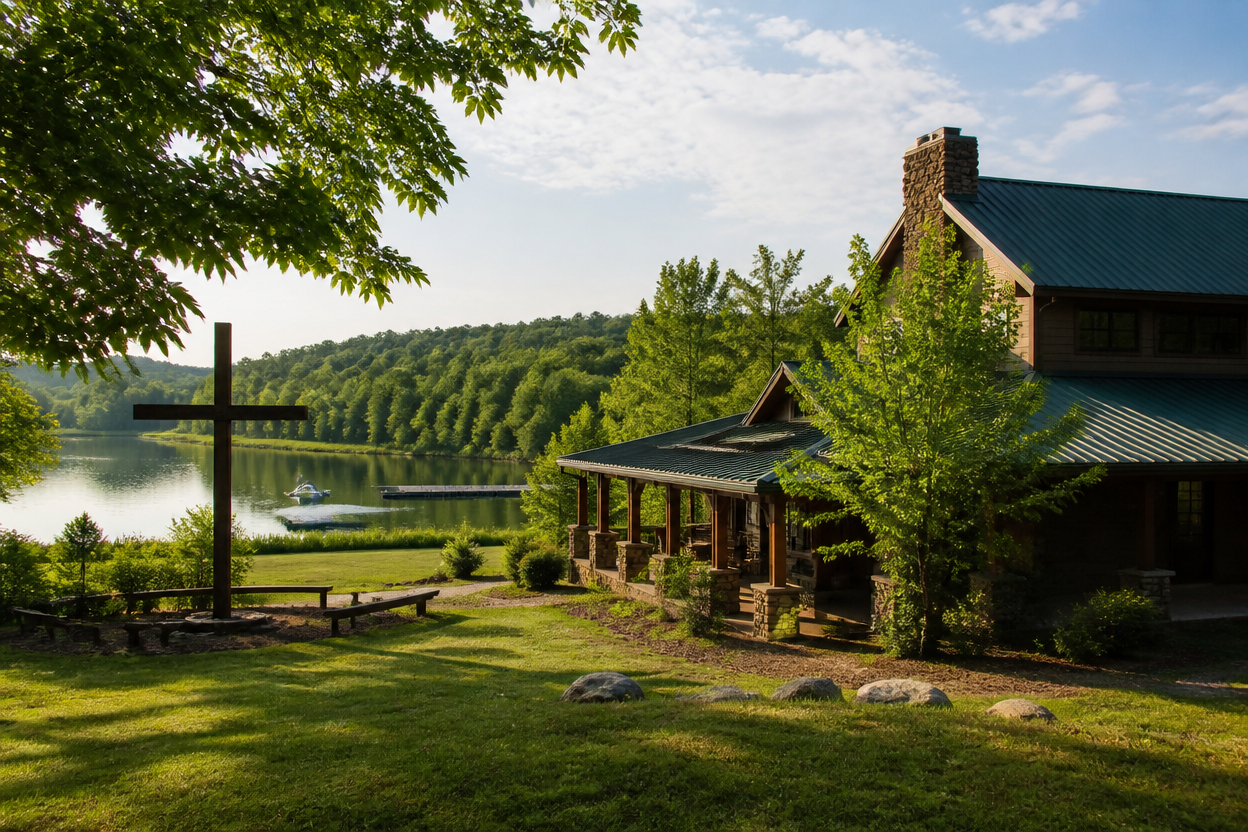
What camps actually need to fund and why donors should care
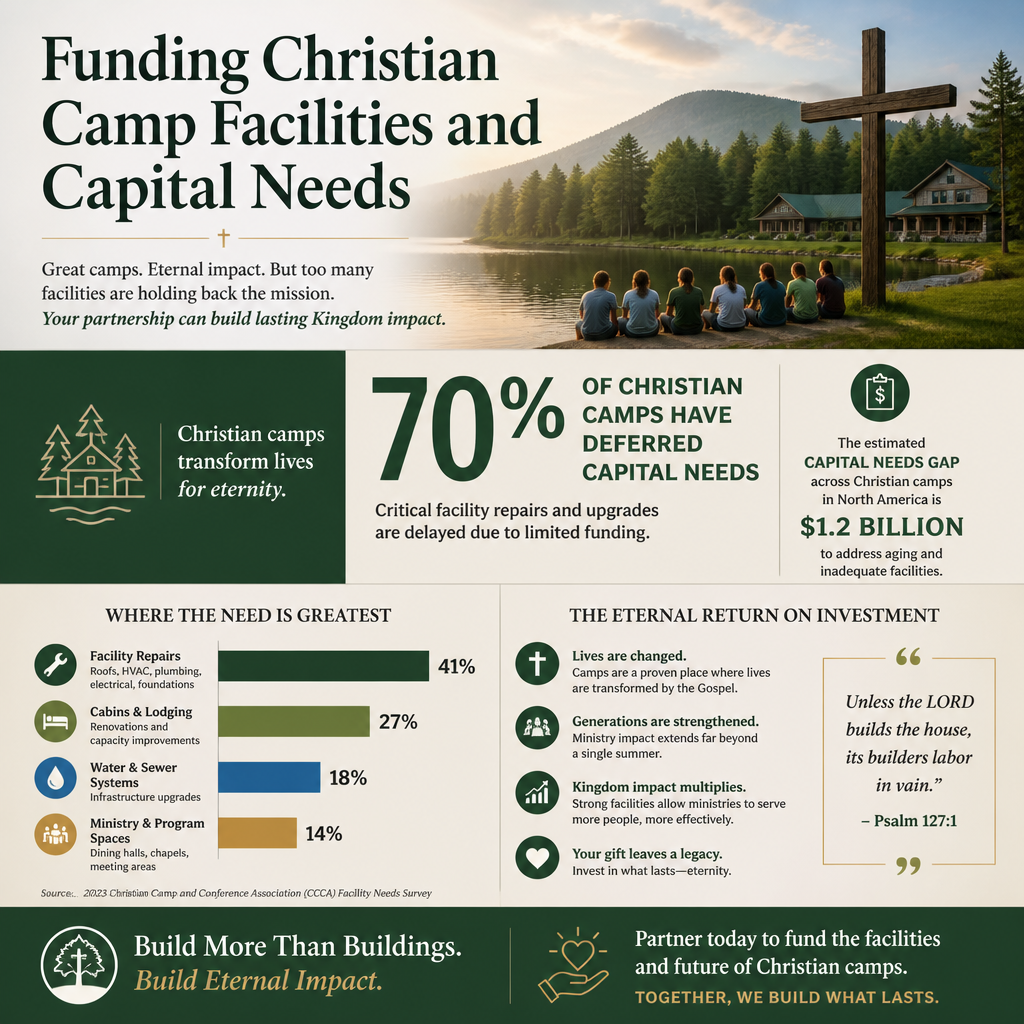
Most camp capital needs fall into a few predictable categories. The work is not glamorous, but it determines whether a ministry can host guests with competence and care. Donors who focus only on new construction often miss the more urgent work of preservation and compliance.
Life safety and code compliance
Fire alarms, sprinkler systems, emergency lighting, accessible egress, electrical upgrades, and kitchen code requirements commonly appear in capital plans. These items are not optional. They are the infrastructure of neighbor-love when minors are in one’s care. Camps should be able to describe what standards apply to their facilities (often depending on state licensure and occupancy classification) and what professional assessments informed their scope.
It is also reasonable to expect evidence of outside expertise. A credible plan will reference licensed engineers, architects, or safety professionals, not only internal volunteers. Volunteer service is a gift to the church, but life-safety design is not the place for guesswork.
Facility renewal and deferred maintenance
Roofs, HVAC, septic and water systems, road drainage, retaining walls, dock systems, and building envelopes have predictable lifecycles. When those cycles are ignored, ministries often face sudden closures or emergency appeals that fracture donor trust. Donors should press for a multi-year maintenance plan, even if the camp is fundraising for a single project today.
The broader nonprofit sector has had to reckon with how chronic underfunding of overhead and infrastructure harms outcomes. The “Overhead Myth” statement—signed by GuideStar (now Candid), Charity Navigator, and the BBB Wise Giving Alliance—argues that overemphasis on low overhead can undermine long-term effectiveness and that donors should look for results and governance quality rather than simplistic ratios. See Candid for the statement and its signatories.
Capacity, accessibility, and program integrity
Some capital projects genuinely expand ministry reach: replacing unsafe cabins, adding ADA-accessible lodging, upgrading a dining hall to accommodate allergies responsibly, or building year-round retreat space that stabilizes revenue beyond summer. Donors should not be allergic to growth, but growth must be tested. A camp should be able to demonstrate that demand exists, staffing can support it, and new capacity will not dilute the discipleship environment that makes the ministry distinctive.
For accessibility in particular, donors can ask whether the ministry has consulted ADA requirements and whether design decisions meaningfully serve campers with disabilities. The U.S. Department of Justice maintains ADA guidance and standards at ada.gov.
How to evaluate a camp building campaign with donor-level rigor
Capital campaigns are vulnerable to spiritualized urgency and financial opacity. Mature donors should not accept either. A Christian camp can pursue bold projects and still submit to disciplined governance, transparent reporting, and honest assumptions.
Start with governance and decision rights
A trustworthy campaign clarifies who approved the project, how conflicts of interest are handled, and how leadership will be held accountable if costs rise. Donors should look for a board that is active, documented in minutes, and willing to exercise real oversight rather than serving as an honorific body.
Across The Most Trusted Standard, governance is not a technicality. It is one of the primary ways donors can discern whether a ministry’s enthusiasm is matched by restraint. For capital projects, this includes written policies on competitive bidding, vendor selection, and related-party transactions.
Demand a coherent financing plan, not only a hopeful total
Campaign brochures often state a goal but not the financing logic. Donors should ask: How much is expected from major gifts versus broad participation? Is the camp taking on debt, and under what terms? What is the contingency plan if pledges are delayed? What reserves are maintained for operations during construction?
The presence of debt is not automatically disqualifying. Some camps use modest, well-structured financing to bridge pledge timing or to prevent disruption of operations. The concern is whether debt becomes a substitute for donor trust. A strong ministry will articulate debt service coverage, sensitivity scenarios, and board-approved limits.
Insist on clear reporting and restricted-gift integrity
Capital donors are often giving restricted gifts. The ministry must be able to honor donor intent precisely and report progress without exaggeration. That includes explaining what happens if the project scope changes: whether donors will be notified, whether funds can be re-designated, and how unused balances are handled.
Transparency is not merely best practice; it is a matter of truthfulness. Camps that handle restricted gifts casually often create future crises even when intentions were sincere.
Ways donors can fund capital needs without distorting the ministry
Christian donors have more options than “fund a building or do nothing.” The right structure can strengthen a camp’s long-term health, reduce crisis fundraising, and preserve program focus.
Prioritize matching gifts that reward broad participation
Matching gifts can serve a campaign well when they are designed to build community ownership rather than to manufacture urgency. A match that is unlocked by participation thresholds or by specific safety milestones can reduce the temptation to chase only a few large checks while neglecting the donor base that sustains operations year after year.
Donors offering matches should also require clear rules: what qualifies, how progress is reported, and what happens if timelines shift. Clarity protects both the donor and the ministry from misunderstandings that later become reputational wounds.
Fund the unglamorous work that keeps doors open
Many camps quietly need funds for roofs, boilers, septic repairs, and electrical modernization. These do not photograph well, but they keep children safe and staff sane. Donors who underwrite this category often provide the most stabilizing kind of generosity, because they prevent the next emergency appeal.
A practical approach is to fund a defined “facility renewal” budget line over three to five years with reporting expectations attached. This pushes the ministry toward planned maintenance rather than reactive triage.
Consider scholarship-plus-facility gifts for integrated stewardship
Some donors rightly want to keep access central, especially for families under financial strain. One constructive pattern is a paired gift: a portion restricted to scholarships and a portion restricted to the facility upgrade that makes those scholarships usable (safe cabins, accessible bathrooms, allergy-aware dining capacity). This approach refuses the false choice between “ministry” and “infrastructure.”
Use verification to reduce information asymmetry
Capital appeals create information gaps: the ministry knows the condition of its assets, the true cost estimate, and the operational implications; donors often see only the glossy rendering. Independent verification exists to narrow that gap. Most Trusted evaluates Christian nonprofits against The Most Trusted Standard, examining faith foundation, financial integrity, governance and leadership, and transparency and effectiveness. For facility-focused giving, this kind of evaluation helps donors distinguish between ministries that are merely ambitious and ministries that are prepared.
What this means in practice is that donors can ask sharper questions with greater charity: not suspicion as a posture, but diligence as love for the people served and for the ministry’s future.
For donors who are also supporting other retreat and youth-disciple-making efforts, the broader context matters. Capital decisions in one camp can affect conference partnerships, denominational networks, and the ecosystem of Christian hospitality. The wider landscape is addressed in Christian Camps and Conferences.
Stewardship that builds places worthy of the gospel
Funding Christian camp facilities and capital needs is a test of whether we can hold two truths together: places matter, and places can become idols. The wisest giving treats capital as a servant of mission, insists on transparent governance, and funds maintenance with the same seriousness as expansion.
When donors require clarity, safety, and honest reporting, they do not hinder ministry; they help preserve it. A well-built cabin, a compliant kitchen, and a thoughtfully designed gathering space can become quiet instruments of grace for decades, because they make it possible for the Word to be taught, prayers to be prayed, and lives to be shaped in communities of trust.



