

Christian aviation ministries send donors updates because their work is both difficult to see and easy to misunderstand. Aircraft disappear over tree lines, into cloud layers, and onto remote airstrips; the ministry impact is often one conversation, one medevac, one delivery, one pastor trained, one community reached. Donors who want to practice disciplined Christian stewardship need reporting that is spiritually coherent, operationally concrete, and ethically honest about what can and cannot be measured.
The deeper question is not whether a ministry communicates, but what kind of communication forms donors toward truth. In an attention economy, it is possible to flood inboxes with emotion while leaving essential accountability unanswered. Mature supporters have learned to ask for updates that illuminate faithfulness, integrity, and results without turning mission stories into marketing.
1. What donors should expect from regular communications
The strongest aviation ministries treat donor updates as an extension of discipleship. They report with gratitude, but also with precision: where flights served, why they mattered, and what stewardship required in the process. That posture aligns with Scripture’s insistence that God’s people “take thought for what is honorable in the sight of all” (Romans 12:17), not as public relations, but as a moral obligation.
Rhythm matters more than volume
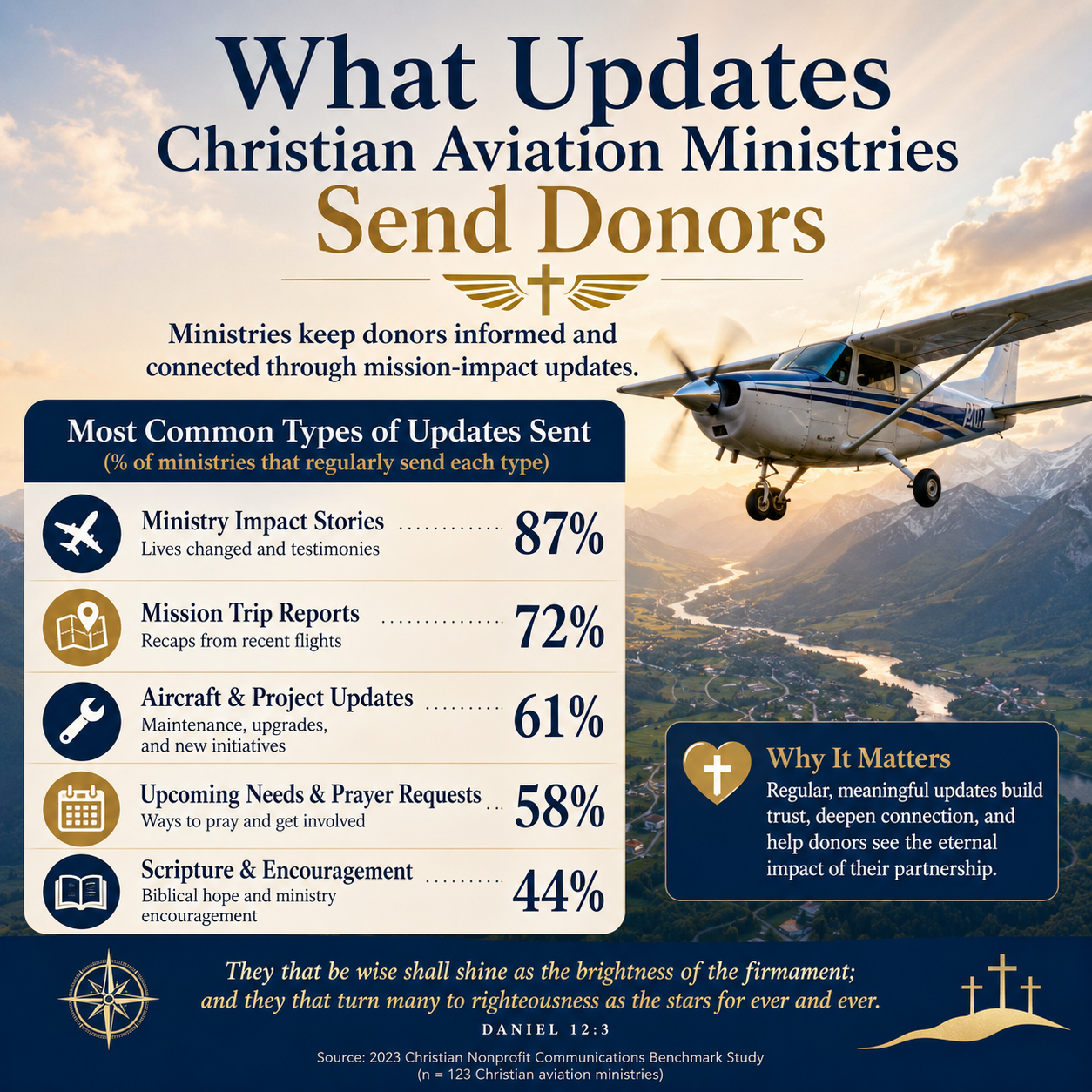
In our verification work at Most Trusted, we observe that reliable cadence tends to correlate with healthier internal systems. Some ministries send monthly e-newsletters and quarterly ministry briefs; others send fewer updates but with greater depth. The goal is not constant contact. The goal is predictable, substantive reporting that respects donors as partners rather than an audience.
Updates should connect operations to mission outcomes
Christian aviation is inherently operational: maintenance cycles, pilot currency, fuel supply, regulatory compliance, weather delays, and safety systems. Donor updates should translate those realities into mission significance. A report that notes “a major maintenance event completed” is helpful; a report that explains what that maintenance prevented, how it protected passengers, and what it cost is more faithful to stewardship.

2. Flight stories that are truthful, specific, and dignifying
Aviation ministries often carry dramatic human stories: emergency evacuations, pastoral transport, Bible distribution, disaster response, and outreach to communities unreachable by road. The best updates tell these stories in ways that honor the image of God in those served, preserve appropriate confidentiality, and avoid turning need into spectacle.
What a credible story includes
Credible narratives are specific without being sensational. They usually include a location, purpose, and constraints (weather, runway condition, medical urgency, security limits). They also show what the ministry did not do: flights postponed for safety, routes declined for policy reasons, or partnerships deferred until local leadership was ready. Those omissions often signal maturity.
When storytelling becomes a warning sign
Christians genuinely disagree about how much detail donors should receive, especially when security or privacy is at stake. Still, there are common red flags: repeated use of dehumanizing images, exaggerated claims of “saving” people, or stories that never acknowledge local churches and leaders. A ministry that routinely centers its own heroism is not simply making a communications choice; it may be revealing a theological posture misaligned with Christian humility.
Donors who want a broader view of the field can track patterns across Christian Aviation Ministries as a category, noting which organizations consistently communicate with clarity and restraint.
3. Operational transparency donors can actually use
Because aircraft are expensive and high-risk, aviation donors should expect unusually clear reporting about operations. This is not suspicion; it is appropriate stewardship. Jesus’ warnings about money were not abstract, and neither is the obligation to manage gifts for the good of others.
Safety and risk reporting without theater
A serious aviation ministry does not treat safety as a slogan. Updates should mention safety culture in practical terms: training days completed, audits performed, standard operating procedures strengthened, and lessons learned. Some ministries will not publish incident details publicly for legal and safety reasons; that is understandable. But donors should still see evidence that safety is governed and measured, not assumed.
Financial reporting that avoids the overhead trap
Many donors were trained to equate low “overhead” with trustworthiness. The field has had to reckon with the fact that this reflex can reward underinvestment in controls and punish ministries that account honestly. Charity Navigator, GuideStar, and the BBB Wise Giving Alliance publicly warned against the “overhead myth,” arguing that administrative and fundraising ratios are poor proxies for effectiveness and can mislead donors when used alone (Charity Navigator).
For aviation ministries, this is especially relevant. Maintenance, safety management systems, pilot training, insurance, and compliance are not optional “administration.” They are mission enablers and moral safeguards. Donor updates should help supporters understand what sound overhead looks like in an aviation context, rather than quietly catering to unrealistic expectations.
4. Evidence of effectiveness without pretending everything is measurable
Some aspects of aviation ministry are quantifiable: flights, passengers, cargo weight, medevac transfers, training sessions delivered. Other outcomes are real but less measurable: strengthened pastoral presence, reduced isolation, improved resilience after disasters, the long arc of discipleship. Donors deserve reporting that uses numbers where they illuminate and refuses numbers where they distort.
Metrics that serve truth rather than optics
One common temptation is to report only what makes a newsletter feel successful. A healthier practice is to report a balanced scorecard: activity measures alongside indicators of quality, stewardship, and partnership. We recommend donors look for the kind of metrics that make it harder to exaggerate—such as showing multi-year trends, comparing planned versus actual activity, and naming the limiting factors.
- Flight purpose breakdown (medical, church support, disaster response, training, logistics)
- Constraints (weather cancellations, runway conditions, security restrictions)
- Asset stewardship (maintenance milestones, aircraft availability, fleet changes)
- Partnership health (local church collaboration, indigenous leadership development)
- Cost drivers (fuel volatility, parts lead times, regulatory requirements)
How ministries should speak about spiritual fruit
Some organizations attempt to quantify conversions or “souls saved” as if air transport were a direct spiritual transaction. Others refuse to name spiritual outcomes at all, for fear of being questioned. A more faithful approach is to report spiritual fruit with reverence and accountability: testimonies submitted by partner churches, training outcomes for pastoral leaders, Scripture distribution tied to local discipleship structures, and prayer requests that reflect real ministry pressure points. Paul’s logic remains relevant: “Neither he who plants nor he who waters is anything, but only God who gives the growth” (1 Corinthians 3:7). Donors can celebrate fruit without demanding a metric that belongs to God.
5. Governance and accountability signals in donor updates
Many donor updates focus on the mission field and neglect the less visible work of oversight: boards, policies, audits, conflicts of interest, executive compensation, and leadership succession. For a high-trust, high-cost ministry category, that omission is consequential. Strong aviation ministries are not only courageous in the air; they are disciplined on the ground.
What disciplined governance looks like in communications
Not every newsletter needs a governance section. But over the course of a year, donors should see clear evidence of independent oversight and sound controls: audited financial statements when applicable, transparent annual reporting, board refreshment, and a willingness to name policy changes. Organizations that meet The Most Trusted Standard tend to communicate these matters without defensiveness, because integrity is not a branding strategy; it is obedience.
How donors can evaluate transparency without cynicism
Some ministries serve sensitive regions and cannot publish names, locations, or certain operational details. Donors should not confuse necessary discretion with secrecy. The practical test is whether the organization offers alternative forms of verification: summarized outcomes, third-party audits, clear financial statements, and responsive answers to donor questions. For donors who want to think carefully about how prayer, partnership, and accountability fit together, ongoing perspective within Praying for and Partnering with Christian Aviation Ministries can help set expectations that are both generous and wise.
FAQs for What updates Christian aviation ministries send donors
How often should a Christian aviation ministry update donors?
Frequency varies, but donors should expect a predictable rhythm and substantive content. Monthly or bi-monthly updates can work well for operational visibility, paired with an annual report that includes financial statements and clear explanations of major strategic decisions. The core question is whether communication is consistent enough to support informed stewardship.
What should donors ask for when an aviation ministry cannot share details for security reasons?
Donors can ask for aggregated reporting that protects sensitive information: counts and categories of flights, regional summaries, governance and financial disclosures, and third-party assurance where appropriate. A ministry can be discreet about names and locations while still being transparent about policies, costs, oversight, and results.
Giving with confidence in a high-stakes ministry category
Christian aviation sits at the intersection of mercy, mission, and material stewardship. Donors are right to desire updates that are vivid enough to pray and specific enough to evaluate. The ministries most worthy of long-term partnership tend to report in a way that honors the people they serve, respects the seriousness of aviation risk, and treats financial accountability as a spiritual duty rather than an external demand.



