
What safety standards guide Christian aviation ministries is not a theoretical question for donors. Aviation is an unforgiving domain: small decisions compound, and weak systems eventually meet hard weather, hard terrain, and hard limits. The Christian conviction that every person bears God’s image presses ministries to treat safety as a moral obligation, not a marketing claim.
Donors often feel a tension here. Aviation ministry stories can read like Acts—rapid travel, remote peoples, urgent medical needs—yet the same urgency can tempt organizations to accept elevated operational risk without the governance maturity to manage it. Christian donors are right to ask for standards that are verifiable, externally anchored, and embedded in daily practice rather than displayed in a brochure.
Safety in aviation ministry begins with accountability to objective standards
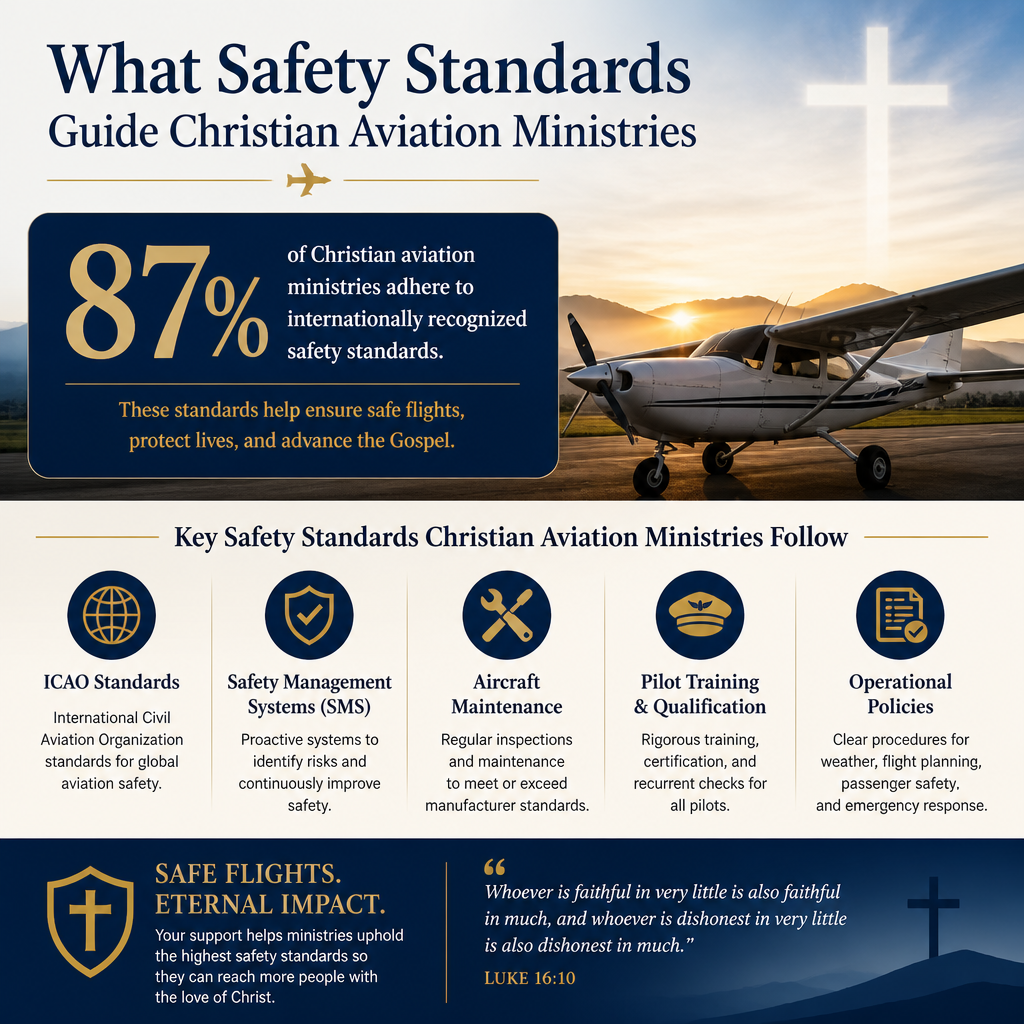
In most countries, civil aviation authorities set baseline requirements for aircraft certification, pilot licensing, maintenance, and operating rules. In the United States that baseline is established by the Federal Aviation Administration (FAA) through the Federal Aviation Regulations, which govern everything from airworthiness to pilot currency and duty limits Federal Aviation Administration. A ministry that cannot demonstrate compliance with the applicable civil aviation authority is not operating on a Christian standard of care; it is operating below the minimum public standard.
What this means in practice is that donors should listen for clear language: certificate types, required inspections, maintenance release procedures, and pilot qualification standards that align with the regulatory environment where the ministry operates. Aviation is one of the few ministry domains where much of “good governance” has a built-in external benchmark. That is a gift—if a board and leadership team are humble enough to receive it.
Regulatory compliance is necessary but not sufficient
Regulations set a floor, not a culture. Two operators can be equally compliant and yet differ dramatically in safety outcomes because one has cultivated a disciplined operational mindset and the other has cultivated workarounds. Mature aviation ministries treat compliance as the beginning of stewardship, then add layers of internal policy, training, and oversight that create a margin.
Standards must fit the mission’s actual risk profile
Many Christian aviation ministries fly in contexts that intensify risk: short or unimproved runways, mountainous terrain, limited weather infrastructure, and sparse maintenance supply chains. The appropriate question is not whether the mission is hard, but whether leadership has matched that complexity with the right standards, people, and decision authority. A low-infrastructure environment calls for more rigor, not less.
A strong safety culture is visible in decisions, not slogans
Most fatal aviation accidents are not caused by a single mechanical failure; they are caused by human and organizational factors that degrade decision-making over time. The National Transportation Safety Board has repeatedly emphasized the importance of systematic risk management and sound operational decision-making across aviation National Transportation Safety Board. Ministries that treat safety as a culture will speak naturally about how decisions are made when schedules, donors, and field pressure collide.
Christian donors should also name the theological stakes. Scripture’s call to love our neighbor does not dissolve under operational pressure. If anything, pressure is where love becomes concrete: delaying a flight when weather is marginal, refusing to launch without adequate maintenance documentation, or turning down a mission tasking when fatigue is present.
Nonpunitive reporting is a hallmark of maturity
Healthy safety culture is not permissive, but it is honest. Pilots and mechanics must be able to report hazards, near-misses, and procedural breakdowns without fear that transparency will be punished. Aviation organizations that discourage “bad news” create a predictable pattern: hazards remain hidden until the costs are irreversible.

Operational authority must be clear and protected
We watch for whether pilots have unquestioned authority to say “no” to a flight for safety reasons, even when a passenger is influential or the mission need is urgent. A ministry can have a faith-forward message and still unintentionally train its staff to spiritualize risk-taking. Mature ministries put in writing that safety decisions are not subject to donor pressure, local political pressure, or internal fundraising narratives.
Maintenance and airworthiness are the donor’s hidden concern
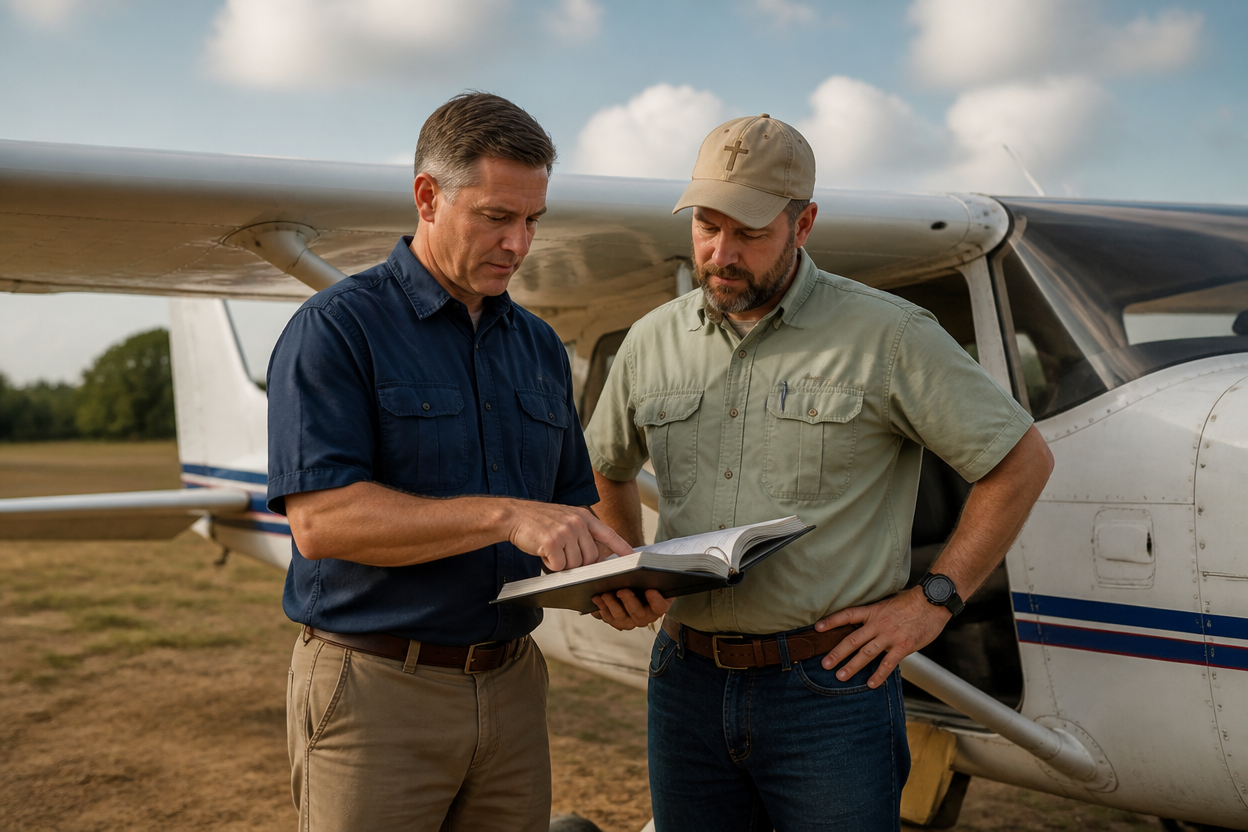
Donors rarely see maintenance logs, parts traceability, or the quality of an operator’s inspection discipline. Yet airworthiness is where integrity becomes measurable. A credible ministry will be able to describe its maintenance program, inspection intervals, mechanic qualifications, documentation standards, and how it handles parts sourcing in remote contexts. These are not “technical details” for specialists; they are the practical outworking of stewardship.
Across our verification work at Most Trusted, we find that organizations with strong operational discipline tend to document what matters and audit it. Ministries that are vague about maintenance systems may still be sincere, but sincerity is not a substitute for process in aviation. This is one reason donors benefit from independent verification that assesses governance and transparency as well as mission outcomes.
Deferred maintenance is not faith
The aviation field has had to reckon with a perennial temptation: the slow normalization of degraded standards. Deferred maintenance can begin as a temporary measure in an austere location and end as a habitual pattern. Christian ministry language can unintentionally sanctify this drift. A mature organization will tell donors, without embarrassment, that it grounds aircraft when documentation or parts are not adequate, even if it slows the work.
Independent inspection reduces moral hazard
When the same small team is responsible for mission pace, maintenance, and reporting to donors, the incentives can blur. Independent inspections, third-party maintenance where feasible, and periodic external audits reduce the temptation to interpret ambiguity in the most convenient direction. This is not distrust; it is wise governance in a high-consequence domain.
Training standards must address judgment, not only stick and rudder skills
Competent flying is more than aircraft control. Mature ministries train for judgment under pressure: weather decision-making, controlled flight into terrain avoidance, fatigue management, and crew resource management. They also recognize that overseas contexts can create “thin margin” operations where the temptation is to accept a little more risk each month until it feels normal.
The harder question is how a ministry builds disciplined pilots over time when turnover, limited instructor access, or mission needs press people into roles before they are ready. This is where donors should look for structured progression, documented check rides, recurrent training, and clear minimums that cannot be waived casually.
Recurrent training is a stewardship practice
Aviation skill decays. Weather patterns, aircraft systems, and operating environments all demand continuing proficiency. Strong ministries budget time and money for recurrent training even when it feels “nonproductive” in mission terms, because training prevents the kinds of failures that can end a ministry’s witness overnight.
Medical transport and humanitarian flying require added safeguards
Some aviation ministries conduct aeromedical transport or disaster response flights. These missions often add time pressure, patient needs, and rapidly changing airspace constraints. In those contexts, higher standards for dispatch, crew qualifications, and operational risk assessment are not bureaucratic obstacles; they are the only ethical way to serve vulnerable people without multiplying harm.
What donors should ask and what credible ministries can document
Donors do not need to become aviation specialists, but they should insist on evidence. Ministries that operate aircraft should be able to answer precise questions and provide documentation that supports the answers. Where appropriate, they should also be willing to describe incidents and learning without defensiveness, because secrecy is rarely compatible with safety.
We recommend donors evaluate aviation ministries the same way they evaluate other complex, high-risk ministries: by looking for aligned theology, disciplined governance, clear financial integrity, and demonstrable transparency. At Most Trusted, The Most Trusted Standard provides a structured way to assess whether a ministry’s claims about safety and stewardship are supported by verifiable practices across faith commitments, leadership oversight, financial controls, and public accountability. For broader context on the sector, donors can review Christian Aviation Ministries.
A short set of donor-level questions
- What civil aviation authority regulates your operations, and how do you demonstrate ongoing compliance?
- Who has final authority to cancel a flight, and how is that authority protected from internal or external pressure?
- What maintenance program governs your fleet, and what documentation is available for inspection intervals and sign-offs?
- What recurrent training do pilots complete each year, and who evaluates proficiency?
- How do you collect hazard reports and near-miss information, and what changes have resulted?
Where transparency signals maturity
Transparency does not mean publishing sensitive security details or names. It does mean being candid about governance: board oversight of aviation risk, the presence of qualified aviation advisors, the existence of written operational policies, and whether the ministry reports safety incidents to appropriate authorities. Donors who want to understand operational safeguards in context may also benefit from our coverage of Aircraft Safety and Pilot Training in Christian Aviation, where these themes are discussed alongside training and risk frameworks relevant to faith-based operators.
FAQs for What safety standards guide Christian aviation ministries
Do Christian aviation ministries follow different safety standards than commercial aviation?
They should not follow lower standards. Civil aviation authorities set mandatory baselines, and ministries should comply fully with the rules applicable to their certificates and operating contexts. Because many ministries fly in more challenging environments than typical commercial routes, mature organizations often add stricter internal minimums for weather, runway conditions, crew rest, maintenance documentation, and recurrent training.
Is it reasonable for donors to ask about accidents or incidents?
Yes, if the questions are framed responsibly. Aviation work carries inherent risk, and incident-free narratives can sometimes signal underreporting rather than exceptional performance. The more meaningful donor question is whether the ministry has a disciplined reporting culture, learns from events, implements corrective actions, and maintains appropriate transparency with regulators, boards, and stakeholders.
Safety is a theological and fiduciary obligation
Aviation ministry can be a profound instrument of mercy, carrying clinicians, pastors, Scripture, relief supplies, and local leaders where roads are impassable and time matters. Yet the same aircraft that extends a ministry’s reach can also magnify the consequences of weak governance. Christian donors serve the Church well when they support ministries whose safety standards are not merely asserted, but demonstrably lived—because integrity in high-consequence work is part of Christian witness.



