
Aircraft safety and pilot training in Christian aviation are not ancillary operational concerns; they are moral questions with financial consequences. Donors are not merely funding fuel and parts. They are funding a ministry’s ability to love neighbors in remote places without presuming upon God’s providence or treating human life as an acceptable cost of urgency.
Christian aviation carries an unavoidable tension: the calling often involves marginal runways, limited weather reporting, maintenance logistics far from certified repair stations, and medical or pastoral urgency that can pressure decisions. Mature ministries do not deny these pressures. They build systems that restrain them. That is where disciplined pilot training, rigorous maintenance, and accountable governance become a form of obedience, not bureaucracy.
Safety in Christian aviation is a stewardship obligation before it is a technical program
Scripture’s insistence on honest weights and measures is not limited to commerce. It reflects a God who requires integrity in the things that can be counted, inspected, and verified. In aviation ministry, those “measures” include aircraft airworthiness, training records, and operational decision-making. When donors ask whether a ministry is “safe,” the responsible answer is not a reassurance. It is a set of verifiable controls.
Christian donors sometimes assume that safety is primarily a matter of pilot skill. Skill matters, but aviation safety is a system property: standards, training, maintenance, oversight, and organizational culture. The National Transportation Safety Board’s safety recommendations and accident investigations consistently show that accidents arise from a chain of contributing factors rather than a single mistake, which is precisely why strong ministries work to break the chain early through policy, training, and supervision (National Transportation Safety Board).
What this means in practice is that a credible Christian aviation ministry treats its safety program as a governance-level responsibility. Board members do not need to be pilots to ask sound questions: Who holds operational authority? How are weather minimums set and enforced? What does the organization do when a pilot declines a flight? How are maintenance deferrals governed? Safety does not flourish where the dominant incentive is to keep flying at all costs.
Why donors should resist the false trade-off between mission urgency and safety
Flight departments are tempted to frame safety and mission as competing goods: “If we slow down, people will suffer.” Yet Scripture never authorizes carelessness in the name of compassion. The Good Samaritan’s mercy is concrete and costly, but it is not reckless. Wise ministries plan in advance so that urgent needs do not force last-minute risk-taking.
Donors also carry a responsibility here. If donor expectations reward heroic imagery more than disciplined prudence, ministries feel pressure to accept flights that should be declined. It is legitimate to celebrate courage. It is not legitimate to incentivize avoidable risk.

Pilot training in Christian aviation is multi-layered and never “one and done”
Donors often ask, “What training do pilots need?” The short answer is that the baseline is the same regulatory foundation required for any professional flight operation, while the practical demands are often higher because ministry routes frequently involve short fields, limited infrastructure, and rapidly changing weather.
In the United States, the Federal Aviation Administration sets training, certification, and currency requirements for pilots and mechanics, and these requirements shape what “qualified” means in formal terms (Federal Aviation Administration). Mature Christian aviation organizations build on those requirements with additional internal standards that match their risk environment, aircraft types, and mission profile.
Initial qualification is only the starting point
A responsible ministry will have clear minimums for pilot experience and endorsements for the aircraft and operating environment it uses. Depending on context, that can include instrument proficiency, mountain flying training, short-field technique, high-density altitude performance planning, and emergency procedures appropriate to terrain and distance from services. The goal is not to create a résumé; it is to ensure that demonstrated competence matches the real conditions the pilot will face.
The harder question is how a ministry verifies readiness beyond checkrides and certificates. Many organizations employ standardization flights, supervised line flying for newer pilots, and periodic skills assessments. Where the mission involves international operations, language, cultural competence, and local airspace procedures are also part of readiness, not peripheral concerns.
Recurrent training and proficiency protect against predictable human limits
Even excellent pilots drift without practice. Instrument scan degrades. Emergency memory items slow. Decision-making becomes less disciplined when it is not rehearsed. Recurrent training is the ministry’s acknowledgment of human limitation and a practical refusal of pride.
In higher-accountability programs, recurrent training includes scenario-based exercises that address the highest-risk moments of the ministry’s profile: weather decision points, fuel planning under uncertainty, stabilized approaches to short runways, go/no-go calls with passengers who are counting on the flight, and mechanical anomalies far from maintenance support. Ministries that treat recurrent training as a calendar obligation rather than a safety instrument typically reveal an underlying cultural problem: they assume experience is a substitute for discipline.
Operational decision-making is a training domain, not only a leadership domain
Many aviation incidents are not caused by lack of stick-and-rudder ability but by judgment under pressure. Christian aviation faces distinct pressure: the passenger is often a patient, a pastor, a missionary family, or medical supplies. Training must explicitly address the temptation to spiritualize risk: “God will protect us,” “The work is too important,” or “We have done this before.” Those statements can be sincere and still be dangerous.
Wise ministries train pilots to name and manage “get-there-itis,” confirmation bias, and plan continuation bias. They also build permission structures so pilots can say no without penalty. A donor should take comfort when a ministry can describe flights it declined and the process that governed the decision.
Maintenance, inspections, and cost are where credibility becomes measurable
Aircraft maintenance costs in Christian aviation are often high for reasons that do not signal waste: parts availability, specialized labor, ferry flights to qualified shops, import duties, and the reality that many operations use aircraft types chosen for rugged reliability rather than low-cost ownership. Donors should not assume that “cheap” maintenance is faithful stewardship. In aviation, cheap is frequently a warning.
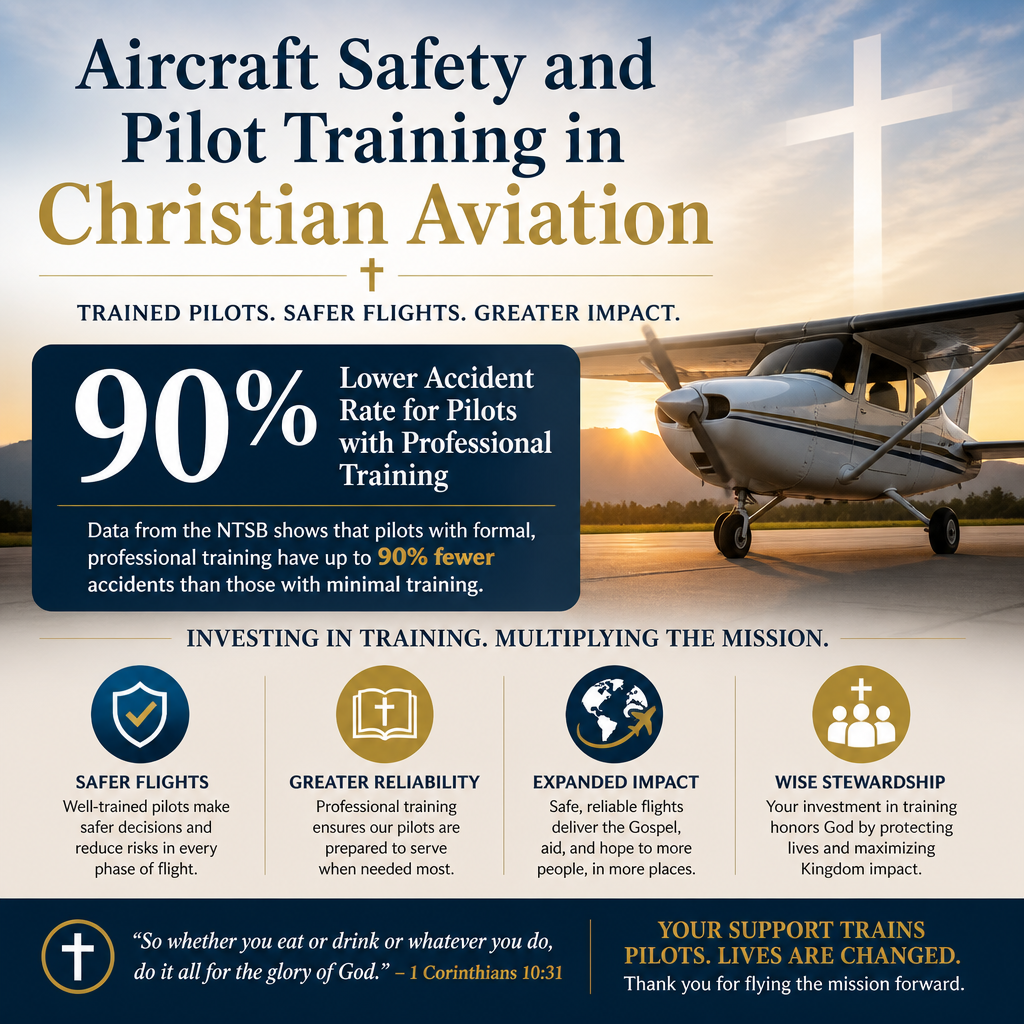
In the United States, FAA rules define required inspections, airworthiness directives, and maintenance recordkeeping, and these frameworks are part of what donors can ask about without needing to be engineers (FAA Airworthiness Directives). Outside the United States, ministries may operate under different civil aviation authorities, but a mature organization will still maintain comparable rigor: traceable maintenance histories, approved parts, and oversight that does not depend on a single person’s memory.
Preventive maintenance and deferred defects reveal organizational maturity
Every operation faces squawks, wear items, and unexpected findings. The question is how a ministry governs them. Deferring maintenance may be lawful in certain cases, but repeated deferrals can function as a quiet transfer of risk onto passengers and communities. Strong ministries have clear policies: what can be deferred, for how long, with whose authorization, and with what compensating controls.
Donors can ask whether the organization budgets realistically for maintenance reserves and engine overhauls. Underfunded reserves can become a spiritualized form of short-termism: believing that future costs will “work out” while the organization continues flying today. Prudence is not unbelief; it is responsibility.
Training and maintenance interact through reporting culture
Ministries that want fewer accidents cultivate earlier reporting. Pilots and mechanics should be able to report concerns without fear of blame. This is not an argument for moral relativism. It is an argument for accurate information. When organizations punish honest reporting, problems go underground until they become emergencies.
Across our verification work, we observe that ministries with strong governance tend to separate operational safety authority from fundraising incentives. When safety authority is vulnerable to program pressure or donor optics, truthful reporting becomes difficult, and maintenance discipline suffers.
Risk management and accountability are where donors can evaluate trustworthiness
Christian donors rightly want to know whether a ministry is both faithful and competent. Aviation makes that evaluation unusually concrete. It is possible to ask for evidence without drifting into cynicism. The goal is not suspicion; it is discernment.
The ministries that meet The Most Trusted Standard tend to show a pattern donors can recognize: clarity about mission, seriousness about governance, truthful financial presentation, and transparent reporting about outcomes and setbacks. Aviation amplifies the need for these qualities because the margin for error is narrow and the consequences of denial are severe.
What safety standards should donors expect to see
Donors can listen for specific, verifiable practices rather than general assurances. Mature organizations commonly maintain written operations manuals, defined weather minimums, flight following procedures, incident reporting pathways, and periodic safety reviews with documented follow-up. Some use formal Safety Management Systems; others apply the same principles without the label. The label is less important than the discipline.
Governance matters here. A board that receives regular safety reporting, reviews serious incidents, and ensures independent oversight is doing spiritual work, not merely administrative work. It is guarding life and reputation, and it is refusing to build ministry on avoidable tragedy.
Weather decisions test theology as much as technique
Weather remains one of the most consequential decision domains in Christian aviation, particularly where forecasts are limited and terrain is unforgiving. The spiritual temptation is to treat risk as a referendum on faith: proceed boldly or be “fearful.” Scripture does not commend that framing. Wisdom literature commends foresight and restraint, and Jesus rejects testing God as a form of presumption.
A healthy ministry treats weather decision-making as a structured process with defined escape options, hard personal minimums, and organizational backing for conservative choices. Donors should be wary of ministries whose narratives consistently celebrate flights completed against the odds, without equal emphasis on flights cancelled for principled reasons.
How donors can ask better questions without becoming aviation experts
Many donors hesitate to ask technical questions because they do not want to appear distrustful. Yet accountability is part of stewardship. Helpful questions include: Who has authority to stop a flight? How are pilots evaluated and trained recurrently? What is the maintenance planning process? How are incidents reported to leadership and the board? What does the ministry do when something goes wrong?
Most Trusted exists to serve that donor instinct with disciplined verification. When we evaluate Christian nonprofits, we examine governance, financial integrity, transparency, and the evidence that ministry claims match operational reality. In aviation contexts, that often includes reviewing whether safety is treated as an accountable system rather than a personality trait. For readers seeking broader context on aviation ministries, we maintain coverage across Christian Aviation Ministries where operational questions intersect with donor trust.
Safety is part of the ministry’s witness
Aircraft safety and pilot training in Christian aviation are ultimately about love of neighbor expressed through competence, restraint, and truthful accountability. The goal is not to eliminate risk—aviation cannot promise that—but to govern risk in a manner worthy of the gospel the ministry proclaims.
Donors can honor that calling by supporting organizations that invest in training, maintenance, and oversight even when those expenses are invisible. Faithful Christian aviation is not sustained by inspirational stories alone. It is sustained by disciplined stewardship that treats every passenger and every community served as bearing the image of God.



