

For Christian donors, the question of what reports to expect from Christian apologetics ministries is not bureaucratic. It is a stewardship question shaped by Scripture’s demand that those entrusted with resources be found faithful (1 Corinthians 4:2). Apologetics ministries often work in contexts where outcomes are harder to count than meals served or churches built, and that reality makes reporting standards more—not less—important.
Across our verification work at Most Trusted, we find that credible apologetics ministries do not treat reporting as donor maintenance. They treat it as a discipline of truth-telling: about doctrine, about finances, about governance, and about what their work can and cannot demonstrate. When reporting is thin, evasive, or overly promotional, donors are forced into a posture Scripture never commends: giving without understanding.
Reporting is a stewardship practice, not a marketing exercise
What donors are biblically justified in expecting
Christian giving is not a transaction; it is an act of worship offered to God and shaped by accountability to him. Ministries that handle donor funds are therefore handling a trust. In the New Testament, Paul takes pains to avoid even the appearance of mishandling money, arranging transparent collection practices “to avoid any criticism” (2 Corinthians 8:20–21). The point is not reputational management. It is public integrity.
For apologetics ministries, this means reports should not read like fundraising copy with a few numbers added. Donors should expect clear disclosures that allow an informed judgment about whether the ministry’s activities align with its stated theological commitments and whether its spending patterns are coherent with its mission.
Why apologetics reporting is uniquely vulnerable to vagueness
Apologetics work often aims at intellectual clarity, spiritual formation, and cultural engagement—goods that resist simple measurement. That is not a defect. It is part of the calling. The vulnerability is that “hard to measure” can become “impossible to evaluate,” and donors are left with brand impressions rather than evidence.
The more a ministry relies on conferences, media, publishing, and speaking platforms, the easier it is to report activity counts while avoiding meaningful evaluation. Mature reporting acknowledges that tension: reach is not the same as fruit, and publicity is not the same as discipleship.

The baseline package donors should receive every year
Documents that should be accessible without friction
At minimum, a well-run apologetics ministry should make a basic set of governance and financial documents readily available. Some of this is standard nonprofit practice; some is simply respect for donors who are discerning. When donors must request basic documents repeatedly, or when an organization treats transparency as an exception, it is rarely a neutral administrative choice.
We recommend looking for the following as a baseline annual reporting package:
- An annual report with ministry activities, major initiatives, and candid reflection on what was learned
- Audited financial statements, or at least a reviewed or compiled financial statement if the budget is smaller
- A current IRS Form 990 (for U.S. nonprofits), posted or readily provided
- A board and leadership list with clear role descriptions and conflict-of-interest practices
- A breakdown of revenue sources and major expense categories that matches the financial statements
External signals that matter to donor discernment
In the United States, Form 990 access is not a discretionary courtesy. The IRS notes that exempt organizations must make their annual information returns available for public inspection, and many donors reasonably expect to find them without obstacles (IRS). For apologetics ministries that appeal to truth, reason, and evidence, resisting basic public disclosure is a theological contradiction as much as an administrative one.
Audited financials are not always feasible for smaller organizations, and sophisticated donors generally understand that. What matters is proportional rigor: appropriate controls, clear oversight, and a willingness to submit finances to independent review as resources allow.
What effectiveness reporting should look like for apologetics
Outputs, outcomes, and appropriate humility
Apologetics ministries can report meaningful evidence without pretending to control conversion, revival, or cultural change. Donors should expect ministries to distinguish between outputs (what was done) and outcomes (what changed). Outputs might include curriculum produced, events delivered, pastors trained, or content distributed. Outcomes may include changes in participant confidence, reported spiritual practices, retention in church communities, or improved ability to articulate Christian doctrine.
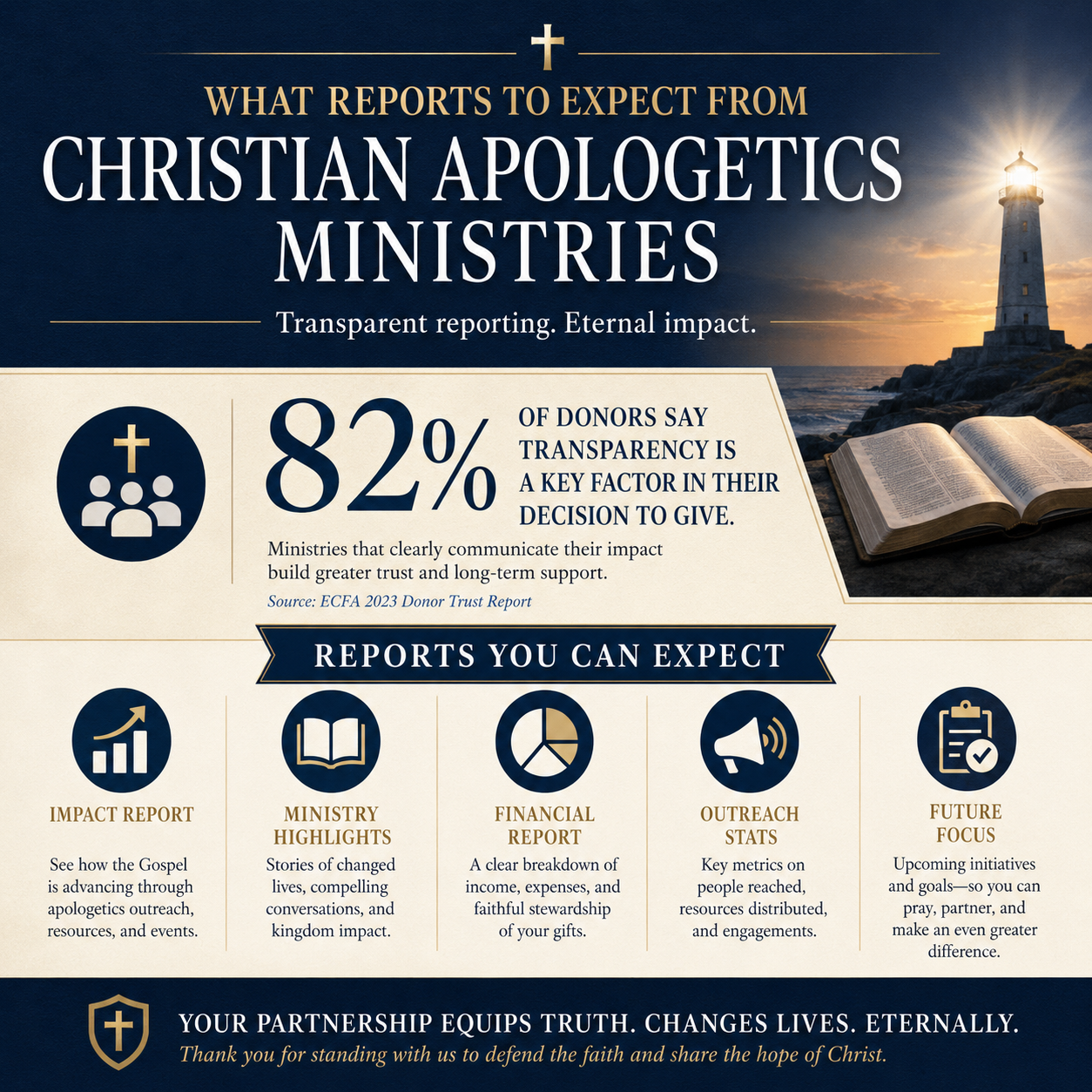
Christians genuinely disagree about what “success” should mean in apologetics. Some prioritize academic credibility and public argument. Others prioritize church-based formation and evangelism. Reporting should therefore make the ministry’s theory of change explicit: what it believes it is doing, for whom, and why those activities plausibly serve the Great Commission and the building up of the church.
Evidence donors can take seriously
In practice, credible effectiveness reporting often includes pre- and post-event surveys, curriculum adoption data, and longitudinal follow-up with pastors or local leaders. It may include peer review for certain scholarly outputs, or external endorsements that are clearly described rather than vaguely implied.
Digital reach metrics can have a place, but sophisticated donors should resist the assumption that “views” equal “disciples.” If a ministry cites platform reach, donors are justified in expecting methodological clarity: what counts as a view, what audience is being reached, and what steps exist to move from attention to formation.
For donors who want a broader framework for how ministries should describe use of funds with integrity and clarity, our coverage of How Christian Apologetics Ministries Use Donations names the reporting practices that tend to support verifiable trust.
Financial integrity and governance signals that should appear in reports
Budget clarity, reserves, and concentration risk
Apologetics ministries can be vulnerable to volatile revenue cycles, especially when funding is concentrated among a small number of major donors or when income depends heavily on event schedules. Mature reports do not hide this. They disclose revenue composition and explain how leadership manages sustainability without fear-driven fundraising.
Donors should look for clarity on designated giving, reserve policies, and how leadership prepares for downturns. A responsible ministry can explain why it holds reserves and how it avoids treating reserves as an excuse for complacency.
Board oversight, related-party transactions, and compensation
Donors should expect reporting that makes governance visible. That includes identifying board members, stating how often the board meets, describing conflict-of-interest policies, and disclosing related-party transactions when they exist. These are not “gotcha” categories. They are basic protections against the temptation to personalize a ministry around a charismatic founder or media figure.
Compensation is a frequent point of donor anxiety. There is no single biblical number that resolves the question, and simplistic outrage is not maturity. Still, donors are right to expect a ministry’s compensation-setting process to be disclosed as a process: independent board review, use of comparable data where appropriate, and clear documentation. This is one place where transparency prevents both exploitation and scandal.
Transparency expectations aligned with The Most Trusted Standard
What ministries that meet higher trust norms tend to publish
The ministries that meet The Most Trusted Standard tend to treat transparency and effectiveness as an ongoing posture rather than an annual deliverable. Reports are supplemented by accessible policies, governance disclosures, and clear explanations of program strategy. Donors are not forced to infer integrity from tone.
What this means in practice is that donors can reasonably expect to find, in plain language, the ministry’s statement of faith, a clear description of how doctrinal accountability is maintained, and how theological disputes are handled when they arise. Apologetics ministries often operate near contested cultural and academic fault lines. Reporting that hides internal accountability structures is rarely neutral.
How to read a report for credibility rather than polish
Well-produced materials are not a problem. The problem is when design substitutes for disclosure. Credible reports include specific numbers tied to financial statements, clear explanations of major changes from the prior year, and sober acknowledgment of limitations. When a ministry’s story is always upward and to the right, donors should ask whether candor has been sacrificed to fundraising pressure.
For donors evaluating organizations in this space more broadly, our ongoing work on Christian Apologetics Ministries outlines the public indicators that tend to correlate with long-term faithfulness and institutional stability.
FAQs for What reports to expect from Christian apologetics ministries
Should an apologetics ministry provide an audited financial statement?
Not always, but donors are justified in expecting appropriate independent financial scrutiny. Larger ministries should generally obtain annual audits, and smaller ministries should at least demonstrate strong internal controls and provide reviewed or compiled statements when feasible. The key question is proportional accountability: whether leadership invites independent examination and provides donors with financial documents that can be reconciled and understood.
What if a ministry reports only stories and media metrics?
Stories can be legitimate evidence of ministry impact, and media metrics can describe reach. But donors should expect more than narrative and attention counts. A credible apologetics ministry should pair stories with clear program descriptions, outcome-oriented evaluation appropriate to its work, and transparent financial reporting. Where outcomes are hard to measure, honest reporting should say so and explain what indicators the ministry uses instead.
Giving with confidence requires more than inspiration
Apologetics ministries serve the church by strengthening confidence in the gospel and equipping believers to speak truthfully in a skeptical age. Because their work is often intangible, their reporting must be unusually clear. Donors should not be asked to choose between theological seriousness and institutional transparency. Faithful stewardship expects both, and serious reporting is one of the most practical ways a ministry can demonstrate that it understands the trust placed in it.



