
Why Christian apologetics ministries engage moral and cultural debates is not a marketing question; it is a discipleship question. When the church’s public claims about truth, goodness, and human dignity are contested, apologetics is often compelled to address not only what Christians believe, but what Christians believe is good.
For donors, this category can feel simultaneously necessary and fraught. Cultural controversy can reward speed, volume, and outrage—none of which are reliable indicators of Christian faithfulness. Yet a retreat from moral argument can also become a quiet concession that the gospel has no public meaning. Serious supporters therefore ask a more careful set of questions: What is the ministry actually trying to do? How does it define faithfulness? And what safeguards keep cultural engagement from becoming partisan captivity?
Apologetics is accountable to the whole counsel of God, not only abstract arguments
The Bible presents moral order as part of God’s revelation
Christian apologetics has always included moral reasoning because Scripture presents creation, conscience, and moral order as arenas of divine disclosure. Paul’s claim that God’s “invisible attributes” are perceived “in the things that have been made” (Romans 1:20) is not reducible to cosmology; it includes moral reality and human accountability. The Christian moral vision is not an optional add-on to “core doctrine.” It is the lived shape of doctrine.
What this means in practice is that apologetics cannot remain only at the level of syllogisms about God’s existence. When a culture’s moral imagination shifts—about sex, embodiment, authority, violence, or the nature of the human person—arguments about God and arguments about the good become entangled. Ministries step into these debates because the questions people are asking are rarely cleanly separated.
Public theology is not identical with partisanship
Christians genuinely disagree about how directly a ministry should speak to specific policies, candidates, or parties. Some donors want explicit political prescriptions; others want principled moral clarity without electoral alignment. The better apologetics ministries distinguish moral teaching from partisan identity, even while acknowledging that moral claims will have political implications.
We observe across our verification work that donors often underestimate how quickly a ministry’s public voice can drift when partisan incentives are allowed to set the agenda. This is one reason we evaluate ministries against The Most Trusted Standard: clarity of Christian mission, governance independence, and public transparency matter more in heated arenas, not less.

Moral and cultural debates are downstream of anthropology
The questions under the arguments are questions about the human person
Many “culture war” controversies are better understood as competing accounts of what a human being is. If the person is fundamentally self-defined will, then limits are oppression and moral norms are negotiable. If the person is creaturehood—made, given, accountable—then freedom is not the absence of constraint but the capacity to flourish in truth.
Apologetics ministries engage these disputes because anthropology is not secondary theology. It is the theological ground for debates about sexual ethics, marriage and family, medical ethics, religious liberty, race and reconciliation, and the obligations societies owe to vulnerable neighbors. When Christian ministries articulate a coherent Christian anthropology, they often clarify what is at stake beneath the headlines.
Cultural credibility has collapsed in part because moral formation has weakened
Many donors sense a gap between Christian confession and Christian conduct in public life. That gap is real, and it damages credibility. Research has also shown that younger Americans increasingly view Christianity through moral categories—often negative ones—before they consider doctrinal truth claims. In a widely cited study, Barna found that majorities of young adults described Christians as “anti-homosexual,” “judgmental,” and “hypocritical” (Barna Group).
That perception does not settle which moral claims are true, but it does shape the apologetic task. Ministries that address moral and cultural questions are often attempting to recover credibility by joining truth to evident humility, repentance, and neighbor-love. The harder question is whether they can do so without adapting Christian ethics to win social approval.
Christian witness is public, but it is not coerced
Persuasion is a Christian mode of engagement
In the New Testament, Christian proclamation advances through witness, argument, and embodied integrity—not through compulsion. Apologetics ministries that enter cultural debates at their best are trying to persuade in a way that honors human dignity, recognizing that people are not merely obstacles to defeat but neighbors to love.
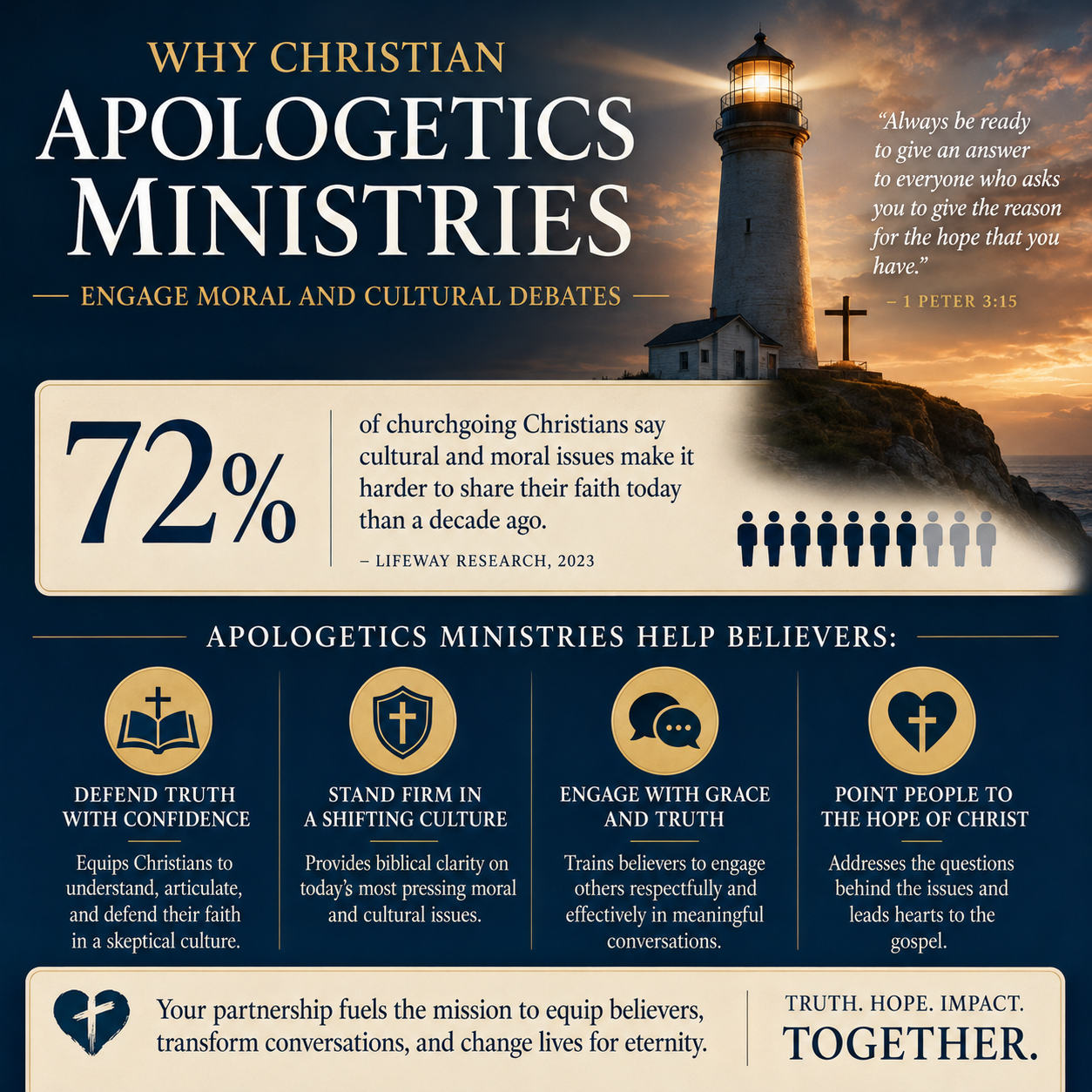
There is also a strategic dimension. In pluralistic democracies, Christian participation in public moral reasoning is part of sustaining a social space where conscience is protected and where religious communities can serve without being forced to violate their convictions. Donors often support apologetics ministries because they see that the freedom to preach and to serve is increasingly contested at the level of moral anthropology.
Digital outrage is a spiritual risk
The most serious danger in cultural engagement is not criticism from outsiders; it is deformation from inside. The attention economy rewards rhetorical escalation. It also punishes patience, careful sourcing, and moral seriousness. This is where governance and leadership discipline become theological issues, not merely operational ones.
For donors evaluating ministries in this space, a few indicators tend to separate enduring witness from reactive commentary:
- Clear doctrinal commitments that shape public claims
- Transparent correction practices when errors are made
- Guardrails against fundraising that trades on fear or contempt
- Evidence of pastoral concern for those harmed or confused
- Independent governance that can restrain the public brand
These are not abstract ideals. They are the sort of practices we look for when we assess ministries’ faith commitments, governance, financial integrity, and public transparency as part of The Most Trusted Standard.
Donors fund apologetics because truth has consequences for people
Cultural debates shape the conditions for evangelism and discipleship
Apologetics is often described as “removing obstacles to faith.” Many of the most significant obstacles today are moral plausibility structures: the assumptions people carry about what a good life is, what freedom means, and whether moral authority is inherently oppressive. When those assumptions harden, even basic Christian claims can sound not merely false but immoral.
This is one reason donors give to apologetics ministries rather than only to local congregations, theological schools, or relief work. They perceive that moral and cultural confusion has created a pre-evangelistic crisis. A ministry that can patiently articulate Christian moral vision—without caricature and without cruelty—can serve the whole church.
The donor’s dilemma is distinguishing prophetic clarity from ideological capture
Christians genuinely disagree about what faithful cultural engagement requires. Some emphasize the need for strong public opposition to moral error; others emphasize the dangers of conflating Christianity with a political platform. Both concerns contain wisdom. The field has had to reckon with prominent moral failures, celebrity scandals, and the temptation to treat political victory as a proxy for spiritual fruit.
For donors seeking to fund this work responsibly, the category pages at Cultural Engagement in Christian Apologetics can help clarify the variety of approaches within apologetics and the typical accountability questions that follow. The goal is not to outsource discernment, but to strengthen it.
Verification matters more when the issues are volatile
Controversy creates unusual temptations for ministries
When a ministry’s voice enters cultural conflict, it faces pressures that are less acute in quieter forms of service. Revenue can become tied to outrage-driven traffic. Donor lists can become segmented by partisan tribe. Staff can be rewarded for attention rather than accuracy. In that environment, the ordinary disciplines of budgeting, board oversight, and transparent reporting become critical spiritual infrastructure.
We also see that controversy can obscure effectiveness. A ministry may be widely shared online and still fail to demonstrate durable outputs: curriculum that is used by churches, training that measurably equips believers, published work that is responsibly sourced, or pastoral resources that are adopted over time. Donors should not confuse visibility with fruit.
What The Most Trusted Standard is designed to clarify
Most Trusted exists because donors deserve verifiable confidence, not merely compelling rhetoric. The Most Trusted Standard evaluates ministries across 15 criteria in four domains: faith foundation, financial integrity, governance and leadership, and transparency and effectiveness. In culturally engaged apologetics, those domains intersect directly with faithfulness.
Consider the practical donor questions that follow:
- Does the ministry’s statement of faith clearly constrain its public advocacy?
- Are related-party transactions disclosed and governed appropriately?
- Is the board sufficiently independent to correct leadership?
- Does the ministry publish accurate, accessible reporting on programs and outcomes?
These questions do not settle every theological disagreement, but they do illuminate whether a ministry is positioned for long-term integrity. Donors looking broadly at this field may also benefit from reviewing Christian Apologetics Ministries as a category, where the variety of apologetic models and accountability expectations becomes clearer.
FAQs for Why Christian apologetics ministries engage moral and cultural debates
Is engaging cultural debates a distraction from evangelism?
It can become a distraction when a ministry treats cultural conflict as the mission itself or when it substitutes political identity for Christian discipleship. Yet cultural engagement is not inherently a diversion. Many moral questions are the questions people bring to the gospel: what human beings are, why moral limits exist, whether authority can be good, and whether forgiveness is possible. Apologetics can serve evangelism by addressing those underlying beliefs with truth and charity.
How can donors tell whether a ministry is being faithful rather than merely provocative?
Donors can look for doctrinal clarity, transparent sourcing, consistent moral tone, and accountability structures strong enough to restrain a charismatic public platform. Financial disclosures, independent governance, and credible reporting on programs matter because they indicate whether the ministry can withstand the incentives of controversy. This is precisely why independent verification exists: to help donors give with confidence when the public pressure is high.
Giving with discernment in a contested public square
Apologetics ministries engage moral and cultural debates because the church’s claims about God inevitably bear on the good, the true, and the human. The public square will not grant Christianity a private corner where doctrine can be affirmed without ethical consequence. For donors, the responsibility is not only to support courage, but to support integrity—ministries whose theological seriousness is matched by accountable leadership, financial honesty, and transparent evidence of faithful work.



