
Anti-trafficking cases need trauma-informed attorneys because the legal process can either protect a survivor’s dignity or unintentionally reproduce the coercion and fear trafficking has already trained into the body. For Christian donors who want their giving to bear fruit that lasts, this is not a technical concern. It is a question of whether justice is pursued in a way that reflects the character of the Judge of all the earth.
Trafficking prosecutions and related civil actions are often built on testimony, credibility assessments, and timelines. Trauma complicates each of those. A survivor may appear inconsistent, emotionally flat, overly compliant, or angry—responses that can be misread as dishonesty when they are, in fact, normal adaptations to prolonged control. A trauma-informed attorney does not lower legal standards; the attorney understands how trauma affects memory, disclosure, and trust, and builds a case accordingly.
Trauma changes how survivors tell the truth
Memory is not a courtroom script
Trauma can fragment memory. Survivors may recall sensory details but struggle to place events in linear order, especially when abuse occurred over months or years under sleep deprivation, intoxication, or threats. In court, that fragmentation is routinely interpreted as impeachment material. A trauma-informed attorney anticipates this and prepares in ways that do not pressure a survivor into false clarity.
This is not speculative psychology. The U.S. Department of Justice’s Office for Victims of Crime has published extensive guidance on the effects of trauma on victims’ participation in the justice system, including common impacts on memory and disclosure patterns U.S. DOJ Office for Victims of Crime.
Delayed disclosure is common, not disqualifying
Survivors frequently disclose in pieces, testing whether the listener is safe. In trafficking, that caution is rational; traffickers often punish truth-telling and manipulate institutions to appear legitimate. If an attorney treats delayed disclosure as willful withholding, the attorney can reinforce the survivor’s learned expectation that institutions exist to control, not to protect.
Scripture’s account of human fear is unsentimental. “A bruised reed he will not break” (Isaiah 42:3) is not a sentimental slogan; it describes a posture of power that refuses to crush what is already fragile. Trauma-informed advocacy is one practical expression of that restraint.

Legal strategy must account for coercion, not only force
The case theory has to fit trafficking realities
Trafficking is often prosecuted and served in environments shaped by misconceptions: that victims immediately seek help, that escape is simple, or that force is always physical. A trauma-informed attorney understands coercive control: threats to family, immigration manipulation, debt bondage, sexual violence, isolation, and the slow conditioning that makes compliance look voluntary.
Federal law reflects this broader reality. The Trafficking Victims Protection Act framework recognizes “force, fraud, or coercion” as core elements of trafficking crimes U.S. Department of Justice Human Trafficking.
Cross-examination can become a second crime scene
Defense counsel has an obligation to test evidence. The question is whether prosecutors and survivor counsel are prepared to prevent cross-examination from becoming an instrument of re-traumatization. When a survivor is pushed into graphic detail, shamed for coping behaviors, or cornered into contradictions that stem from trauma, the proceeding can feel like a replay of captivity—again under an authority figure, again in public, again with limited control.
Trauma-informed attorneys prepare survivors with precision. They also use appropriate motions and evidentiary tools—where available—to reduce needless exposure while preserving the defendant’s rights. Serious justice must be both rigorous and humane.
Donor-funded services rise or fall on trust in the legal process
Survivor engagement depends on whether systems feel safe
Many Christian donors rightly fund safe houses, counseling, job readiness, and discipleship. Yet a survivor’s ability to stabilize can be derailed by the legal system itself if legal professionals treat the survivor as a case file rather than a person. When survivors disengage from legal processes, traffickers face less accountability, and the survivor may lose access to restitution, immigration relief, expungement, protective orders, or custody protections that can be essential to long-term stability.
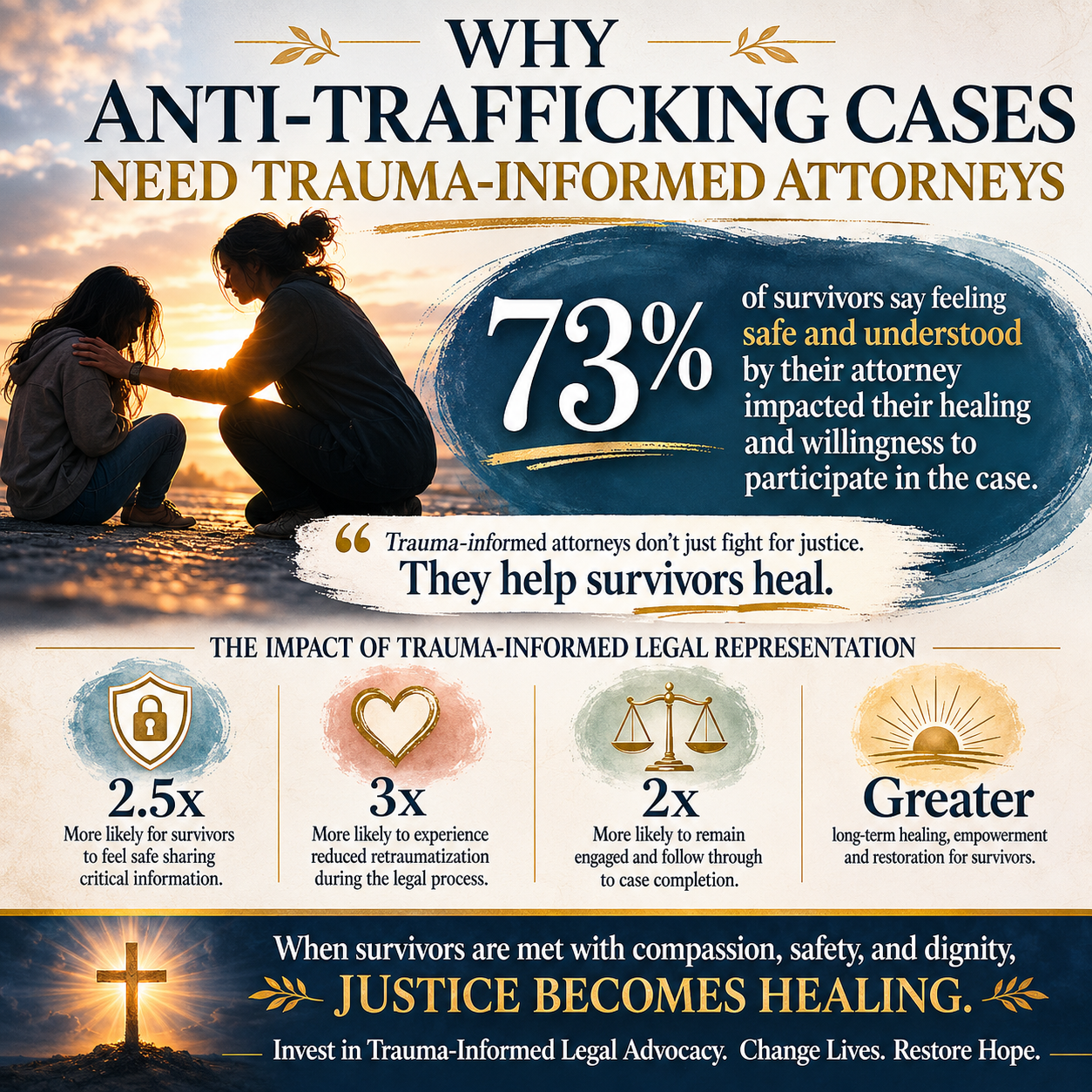
Across our verification work at Most Trusted, we observe that ministries serving trafficking survivors are most effective when legal advocacy is integrated with case management and clinical support rather than treated as an afterthought. The ministries that meet The Most Trusted Standard tend to be clear about referral pathways, confidentiality, and how they prevent secondary trauma inside their own programs.
Church partners often underestimate legal complexity
Local churches frequently become first responders: a pastor gets a call, a small group hosts an emergency need, a benevolence team pays for a hotel, a counselor flags exploitation. These acts of mercy matter. But trafficking-related legal needs can include criminal prosecution support, civil claims, family law, housing issues, victim compensation, and immigration. An attorney who is not trauma-informed may be competent in one domain and still unintentionally harm the survivor through communication style, pacing, or the inability to coordinate with clinical care.
For donors, this creates a practical question: are we funding ministries that understand the difference between legal services that are merely available and legal services that are actually safe and effective?
What donors should look for in trauma-informed legal partnerships
Signals of quality without romanticizing the work
Christians genuinely disagree about anti-trafficking tactics, especially where advocacy intersects with policing, prosecution, and public narratives. Some concerns are warranted: sensational storytelling can distort reality; poorly designed raids can endanger victims; and overconfident claims about “rescues” can confuse publicity with outcomes. A trauma-informed legal approach does not resolve these tensions automatically, but it does tend to produce more careful, accountable practice.
As donors evaluating a ministry’s legal support model—whether the ministry employs attorneys, partners with a legal aid organization, or funds pro bono networks—several indicators are worth examining:
- Clear survivor-consent protocols for information sharing across staff, clinicians, and attorneys
- Training aligned with evidence-based victim advocacy and ongoing supervision to prevent burnout and boundary failures
- Policies for court accompaniment and preparation that reduce re-traumatization without coaching testimony
- Coordination with licensed clinical care, including referral pathways when legal stress triggers crisis
- Measured public communication that avoids identifying details and does not trade confidentiality for fundraising
Verification should extend beyond good intentions
Good intentions do not guarantee safe legal practice. Donors should ask ministries not only whether they “work with attorneys,” but how those attorneys are selected, trained, and supervised; how conflicts of interest are handled; and what happens when a survivor chooses not to cooperate with prosecution.
This is one reason Most Trusted exists. We evaluate Christian nonprofits against The Most Trusted Standard, examining faith commitments alongside financial integrity, governance, and the ministry’s demonstrated transparency and effectiveness. When donors are discerning about legal partnerships, they honor both the survivor’s dignity and the donor’s stewardship.
For readers tracking the broader landscape of Christian Anti-Trafficking Ministries, legal quality is often the hidden hinge between compassionate care and lasting justice.
Trauma-informed attorneys strengthen both justice and mercy
Protection is part of righteousness
Scripture’s call to justice is not only punitive; it is protective. “Rescue the weak and the needy; deliver them from the hand of the wicked” (Psalm 82:4) assumes that the vulnerable can be further harmed if authority is careless. In trafficking cases, that harm can come from interrogations, poorly timed subpoenas, public exposure, or adversarial tactics that ignore trauma. Trauma-informed attorneys practice a kind of disciplined mercy: they pursue accountability while limiting avoidable injury.
Accountability requires credible, sustainable testimony
Prosecution is not the only goal, but it is often necessary. A survivor’s willingness to engage, endure discovery, and stand through proceedings is shaped by whether the legal team is trustworthy. Trauma-informed attorneys are more likely to build reliable evidence beyond a single witness, to corroborate carefully, and to protect survivors from being treated as disposable tools for conviction.
When legal support is done well, it can strengthen broader restoration efforts: stable housing, employment, family reunification, spiritual care, and long-term counseling. When it is done poorly, it can destabilize everything else a ministry is funding.
Donors who want to understand where legal care fits within ministry partnerships will often find clarity by studying Legal Support and Partnerships in Christian Anti-Trafficking Work and asking ministries to describe their model with specificity rather than slogans.
FAQs for Why anti-trafficking cases need trauma-informed attorneys
Does trauma-informed lawyering make it harder to prosecute traffickers?
No, although it can change tactics and timelines. Trauma-informed attorneys tend to reduce preventable breakdowns in survivor participation, prepare testimony more responsibly, and build corroboration rather than relying on a survivor to perform a flawless narrative under pressure. Those practices can strengthen a case while also reducing harm.
What is a practical question donors can ask a ministry about legal partnerships?
We recommend asking: “How do you ensure survivors give informed consent for legal action, and what support do you provide if they decide not to participate in prosecution?” A thoughtful answer usually reveals whether the ministry understands coercion, respects survivor agency, and has a legal model that aligns with long-term care rather than short-term outcomes.
Justice that heals is not optional
Anti-trafficking work will always involve imperfect institutions and contested strategies. Yet the central moral fact remains: survivors are image-bearers, not evidence containers, and our legal systems must not treat them as expendable. Trauma-informed attorneys are one of the most concrete ways the church’s concern for justice becomes credible in practice. For donors, supporting ministries that pursue legally rigorous, trauma-aware advocacy is a form of stewardship that seeks both accountability and restoration.



