
What legal aid Christian anti-trafficking ministries fund is often the difference between a survivor stepping into lasting safety and being pulled back into coercion by threats, debt, or a legal system they do not understand. Donors who care about rescue must also care about what happens after first contact, because trafficking is sustained not only by violence but by vulnerability, isolation, and the misuse of law.
Christian anti-trafficking work has matured enough to acknowledge a difficult truth: legal systems can protect, but they can also retraumatize. Survivors may face criminal charges for acts committed under force, family court proceedings that determine custody, immigration hearings, housing disputes, and civil claims that decide whether restitution is even possible. When ministries fund legal aid well, they are not “adding overhead.” They are removing chains.
Legal aid is not an add on to restoration
Justice is a biblical category before it is a program category
Scripture treats justice as a public obligation, not a private sentiment. “Give justice to the weak and the fatherless; maintain the right of the afflicted and the destitute” (Psalm 82:3). For trafficking survivors, “maintain the right” often means competent counsel, trauma-informed advocacy, and patient accompaniment through long timelines. Without that, the survivor’s voice can be crowded out by prosecutors, defense attorneys, landlords, debt collectors, and abusers who understand the system better.
What this means in practice is that many effective Christian ministries fund legal aid as a core part of restoration, alongside housing, counseling, and discipleship. Across our verification work at Most Trusted, we observe that ministries meeting The Most Trusted Standard tend to describe legal services with clarity: the goal is not institutional self-protection, but survivor protection and durable outcomes.
Trafficking is highly criminalized and survivors often carry the consequences
Survivors commonly emerge from exploitation with criminal records, fines, and warrants that were accumulated while they were under control. Those records then block employment, housing, professional licensing, and even child custody. The U.S. Department of Justice recognizes the centrality of legal services in victim assistance, including help with protection orders, immigration relief, and record clearing for trafficking victims U.S. Department of Justice. This is not a peripheral need; it is a predictable barrier after exploitation.

The core legal services ministries most often support
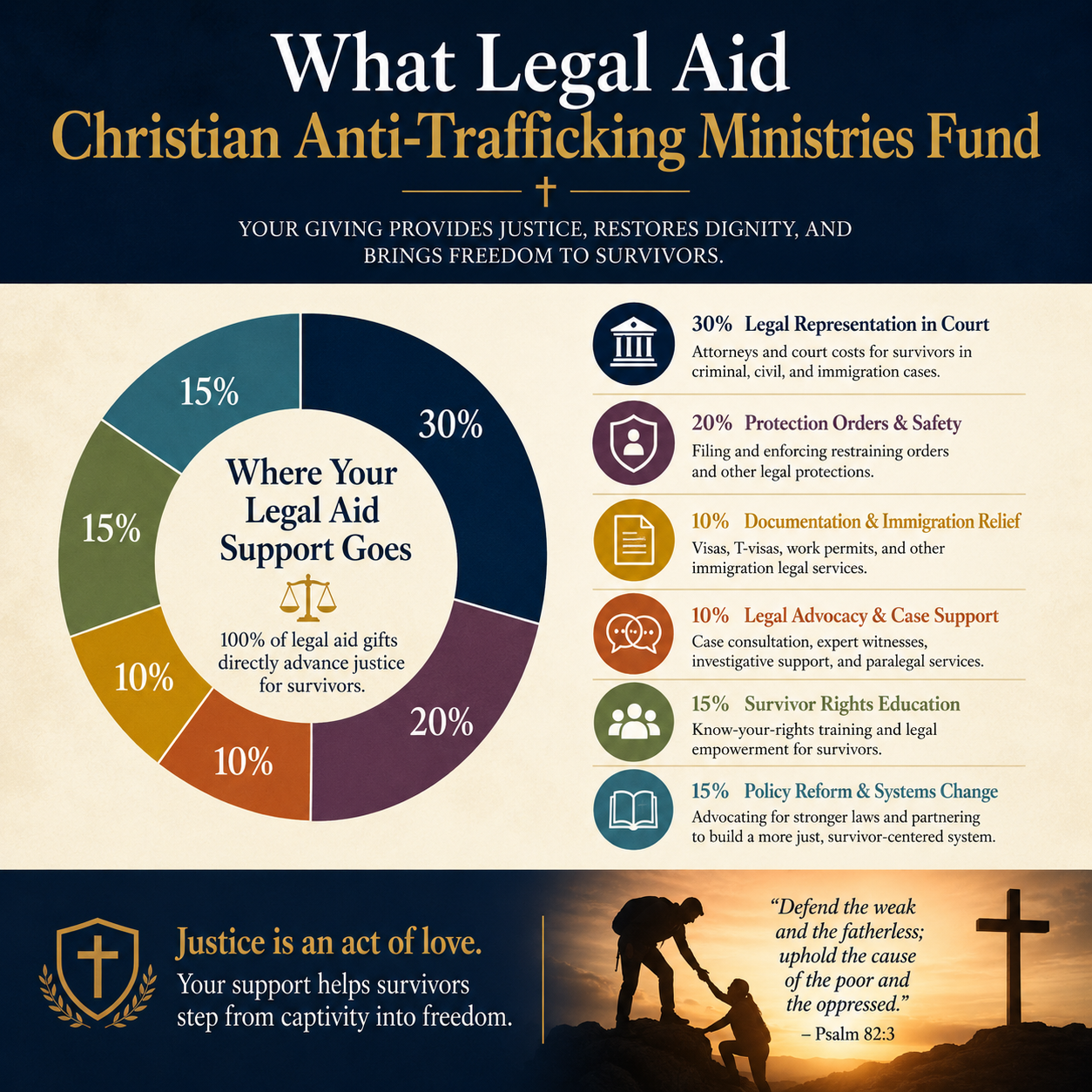
Representation in criminal and civil systems
Legal aid in anti-trafficking ministry typically clusters around representation and advocacy in systems that survivors must pass through to regain stability. Ministries rarely provide all services directly; many fund partner law firms, legal clinics, or pro bono networks, and then coordinate case management so survivors are not left to navigate alone.
Commonly funded legal services include:
- Criminal defense and record relief, including trafficking-victim vacatur, expungement, and fine mitigation when available under state law.
- Protective orders and related safety planning when traffickers or buyers continue harassment, stalking, or threats.
- Family law, including custody, visitation, and divorce proceedings where coercion and credibility attacks are common.
- Immigration legal services, such as T visas, U visas, asylum-related claims, and work authorization.
- Housing and benefits advocacy, including landlord disputes, eviction defense, and access to public benefits when eligible.
These categories are not theoretical. They reflect the places survivors most often encounter gatekeepers who can either recognize coercion and trauma or misread it as instability and noncompliance.
Legal accompaniment that respects trauma and agency
Christians genuinely disagree about the line between “rescue” and “agency,” but legal aid is one place where the disagreement becomes concrete. A trauma-informed attorney will not pressure a survivor into a course of action that fits an organization’s metrics. Instead, they will explain options, likely outcomes, and risks in plain language, and then honor the survivor’s decisions wherever possible.
For donors, this is a discernment point. Ministries that fund legal aid well treat survivors as image-bearers capable of meaningful consent, not as projects. The goal is protection without paternalism.
Specialized legal aid that donors often overlook
Immigration relief and identity repair
Immigration status is a lever traffickers frequently exploit: threats of deportation, confiscation of documents, and isolation from trustworthy counsel. Funding immigration legal services can be one of the most direct ways donors reduce a survivor’s vulnerability to re-exploitation. The U.S. Citizenship and Immigration Services outlines protections for victims of human trafficking, including T nonimmigrant status and related benefits USCIS.
Identity repair is similarly strategic. Survivors may need help securing identification, correcting records, and restoring documentation that traffickers destroyed or controlled. Without IDs, survivors cannot work legally, sign leases, open bank accounts, or enroll in certain programs. These are mundane tasks with profound stabilizing effects.
Restitution, civil damages, and economic justice
Donors often assume that criminal convictions will naturally lead to restitution. In practice, restitution can be contested, delayed, or never collected. Some ministries therefore fund civil litigation support, victim compensation claims, and financial advocacy. The legal work is painstaking, and outcomes vary by jurisdiction and defendant resources, but the pursuit itself can matter: it signals that exploitation has a cost, and that survivors are not expected to bear it alone.
This is also where donors should expect complexity. Civil litigation can expose survivors to invasive discovery and credibility attacks. A ministry funding this work should be able to explain how it weighs the potential benefit against the emotional and safety risks, and what safeguards are in place.
How legal partnerships function in credible anti-trafficking work
Why ministries partner rather than practice law themselves
Most ministries are not law firms, and they should not pretend to be. The strongest models typically involve carefully governed partnerships with licensed attorneys, legal aid organizations, law school clinics, and survivor-informed advocates. In those arrangements, the ministry provides funding, case management coordination, transportation, documentation support, and wraparound care, while the attorney provides legal counsel and representation under ethical rules.
This partnership model also reduces a common risk: role confusion. Survivors benefit when spiritual care, social services, and legal representation remain distinct enough to protect confidentiality, prevent coercion, and comply with professional standards.
Where donors can evaluate legal work with maturity
Legal outcomes are not as easy to count as meals served. Case timelines can extend for months or years, and confidentiality limits what can be publicly shared. Mature donors therefore look for indicators of disciplined practice rather than dramatic storytelling.
Across our verification work, we find it helpful to ask whether a ministry can document:
- Referral and intake criteria that avoid cherry-picking only “easy” cases.
- Written MOUs with legal partners that clarify roles, confidentiality, and survivor consent.
- Trauma-informed training for staff who support survivors through legal processes.
- Safety protocols for court appearances, address confidentiality, and digital security.
- Outcome definitions that include stability markers, not only convictions or courtroom wins.
Donors seeking a broader view of how collaborations and safeguards fit within the field can also consult Legal Support and Partnerships in Christian Anti-Trafficking Work, where we track common models and decision points that affect trustworthiness.
What donors should look for when funding legal aid
Transparency without violating survivor confidentiality
Transparency in anti-trafficking work is always constrained by safety and privacy. That is not an excuse for vagueness; it is a call for careful reporting. Ministries should be able to describe legal services in aggregate: number of clients served, types of cases, partner organizations, general timelines, and non-identifying outcomes. They should also name limits plainly, including why certain data cannot be published.
In our work at Most Trusted, The Most Trusted Standard presses ministries toward this balance: donor-visible clarity about governance, finances, and effectiveness, paired with survivor-protective discretion. When that balance is missing, donors are asked to fund a story rather than a system.
Faithful witness without triumphalism about justice
Christian donors rightly long for justice, but Scripture does not promise that every earthly court will vindicate the oppressed. The cross itself is the most sobering proof that legal processes can be weaponized. Ministries that fund legal aid responsibly prepare donors for mixed outcomes: dismissed charges can still leave a survivor with trauma; a conviction can still leave a survivor economically fragile; a protection order can still be violated.
That realism is not cynicism. It is a refusal to confuse the Kingdom of God with a court docket. It also guards against the temptation to treat survivors as instruments for institutional credibility.
For donors deciding where to give within the wider landscape of Christian Anti-Trafficking Ministries, legal aid is a meaningful marker of seriousness. It indicates a ministry is willing to do slow, technical work that rarely produces clean narratives but often produces durable safety.
FAQs for What legal aid Christian anti-trafficking ministries fund
Does funding legal aid mean a ministry is focused on prosecution over care?
Not necessarily. Competent legal aid often supports care rather than replacing it: clearing a record so a survivor can work, securing custody so children are not used as leverage, obtaining immigration status so threats of deportation lose power, or negotiating safer housing. Some ministries prioritize collaboration with law enforcement; others limit involvement because of survivor safety or community mistrust. A credible ministry should explain its posture, its safeguards, and how survivor consent is honored.
How can donors assess impact when legal cases are confidential?
Donors can look for disciplined reporting at the program level without asking for identifiable stories. Strong indicators include clear descriptions of services offered, partner qualifications, written protocols, aggregated outcomes, and audited financial reporting that shows legal aid spending is consistent with stated priorities. At Most Trusted, our evaluations against The Most Trusted Standard emphasize this kind of verifiable clarity, especially where confidentiality is rightly maintained.
Funding legal aid is funding a survivor’s future
When donors fund legal aid in Christian anti-trafficking work, they are often funding the unglamorous steps that make restoration possible: a clean record, lawful status, a safe custody order, a sealed address, a resolved debt, a court system navigated with dignity. Justice in Scripture is not abstract. It is protection for the vulnerable, restraint for the violent, and a community ordered toward what is right.



