
How Christian anti-trafficking ministries work with prosecutors is one of the least visible, most consequential questions in the modern anti-trafficking movement. Donors often see a survivor story or a rescue headline, but the path from disclosure to conviction runs through a legal process that is slow, adversarial, and frequently retraumatizing.
For Christian donors, this is not merely a technical matter. Scripture ties justice to God’s own character: “The LORD loves righteousness and justice” (Psalm 33:5). But Christian ethics also requires clarity about what the state can and cannot do, what a ministry should and should not do, and where good intentions can unintentionally jeopardize a case or a survivor’s long-term safety.
Prosecutors do not need ministries to be police but they often need them to be stable partners
What prosecutors are tasked to prove
Prosecutors carry the burden of proof in court, and trafficking cases are evidentiary burdens by nature. In the United States, the federal legal definition of “severe forms of trafficking in persons” centers on (1) sex trafficking induced by force, fraud, or coercion, or involving a minor, and (2) labor trafficking through force, fraud, or coercion under the Trafficking Victims Protection Act, summarized by the U.S. Department of State at state.gov. A ministry may be the first to hear a disclosure, but it is the prosecutor who must assemble admissible evidence, establish elements of the offense, anticipate defenses, and protect due process.
What this means in practice is that prosecutors value information that is documented, time-stamped, consistent, and lawfully obtained. They do not need ministries to conduct interrogations. They need ministries to avoid contaminating testimony, to preserve potential evidence appropriately, and to ensure the survivor is supported without being coached.
Why ministries often become the trusted bridge
Trafficking survivors frequently have layered vulnerabilities: prior abuse, unstable housing, immigration fears, addiction, coercive control, or distrust of institutions. The National Human Trafficking Hotline reports thousands of signals and identified cases each year, reflecting the scale of vulnerability and the complexity of identification; the hotline’s annual data are published by Polaris at polarisproject.org. In that context, prosecutors and investigators may rely on credible community partners who can maintain consistent contact, provide practical stabilization, and help survivors understand what participation in a case will require.
Christian ministries that are mature about this partnership resist the temptation to measure success by immediate legal outcomes. They treat legal cooperation as one possible pathway within a broader commitment to restoration, safety, and discipleship offered without coercion.

Healthy collaboration begins with role clarity and disciplined boundaries
Ministries must not become investigators
One of the fastest ways to harm a case is for a well-meaning helper to start gathering “details” in a way that resembles an interrogation. Defense counsel will scrutinize how statements were elicited, whether they were prompted, whether notes were altered, and whether the survivor’s memory was shaped by repeated retellings. Prosecutors generally prefer that a survivor’s substantive narrative be obtained through trained forensic interviewing or controlled law-enforcement processes, not through ministry intake forms designed for services.
Role clarity protects everyone. Law enforcement investigates. Prosecutors prosecute. Ministries serve. When those lines blur, courts can question reliability, and survivors can feel that care is contingent on cooperation.
Documentation can help or harm
Prosecutors often need records, but not every record helps. A ministry’s case notes can become discoverable, and imprecise language can be misread in court. Mature ministries develop disciplined documentation practices: factual observations separated from interpretation, careful time frames, secure storage, and a clear understanding of confidentiality limits.
This is also where donors should ask better questions. Funding “frontline work” without funding policies, training, and secure systems creates avoidable risk. Across our verification work at Most Trusted, we observe that ministries most credible to prosecutors usually have written protocols, staff training in mandated reporting where applicable, and a sober understanding that compassion does not eliminate legal exposure.
- Clear written boundaries for staff and volunteers on what to ask and what not to ask
- Standardized intake processes that prioritize safety planning over narrative detail
- Secure, access-controlled recordkeeping with retention and deletion policies
- Mandatory training on confidentiality, subpoenas, and required reporting
- Established referral pathways to legal aid and trauma-informed clinicians
Trauma-informed care is not a slogan when testimony is on the line
The courtroom can replicate coercion dynamics
Even when the legal system is functioning properly, a trafficking prosecution can feel like a loss of control: repeated interviews, medical exams, public testimony, and cross-examination that probes inconsistencies. Trauma can impair memory encoding and retrieval, and survivors may appear “inconsistent” when they are describing a reality shaped by fear, dissociation, or prolonged manipulation. Prosecutors who understand trauma still must address those inconsistencies in a way that satisfies a jury and withstands appellate scrutiny.
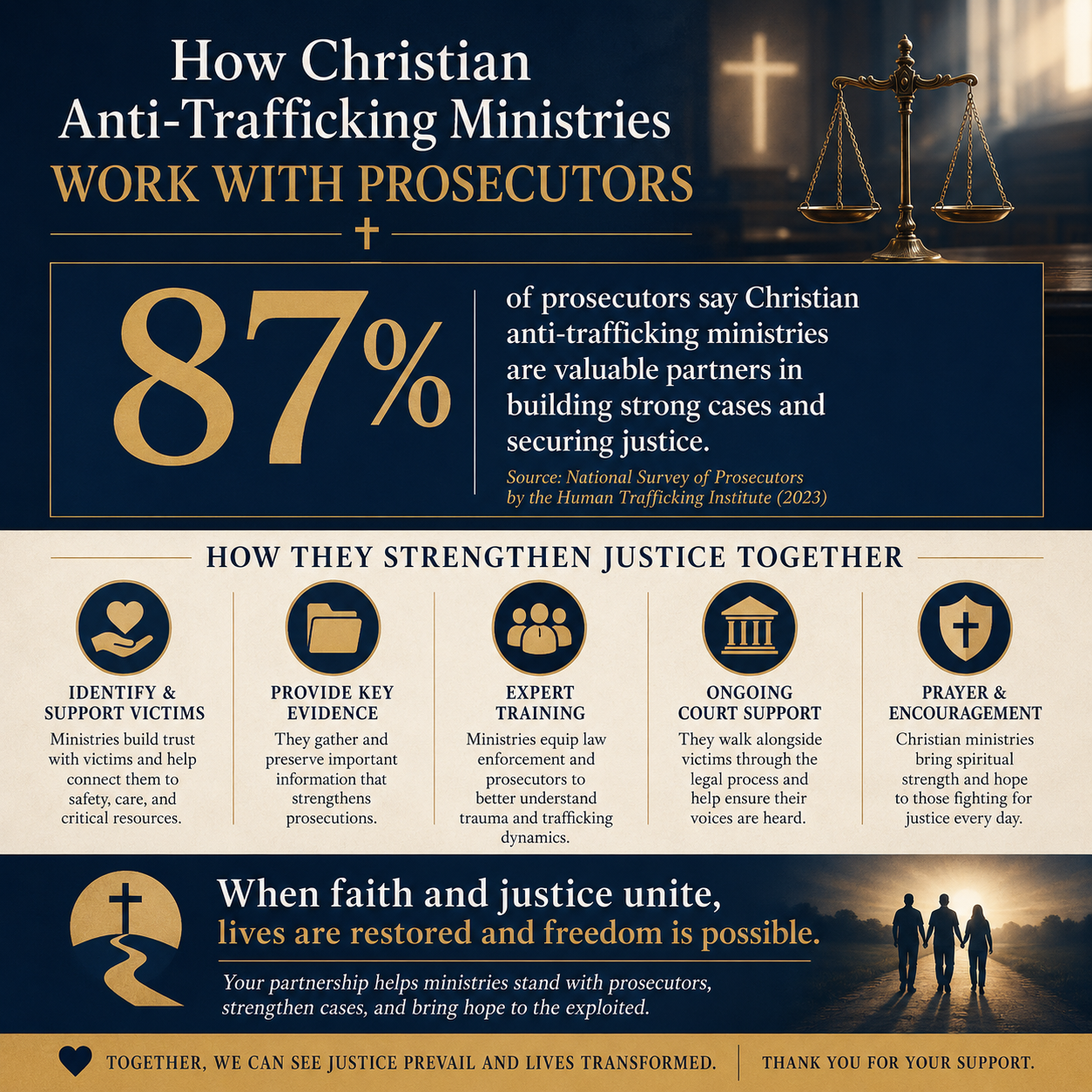
Ministries can support this process without scripting it. They can provide stability that reduces crisis-driven disappearance, help survivors keep appointments, and ensure the survivor has access to competent counsel and victim-witness services. They can also prepare a survivor for what will happen procedurally, while refusing to rehearse testimony content.
Advocacy without coaching
Christians genuinely disagree about how strongly ministries should push for legal cooperation. Some fear that urging testimony risks manipulating survivors. Others fear that avoiding the legal path leaves traffickers free to harm more people. The wiser question is whether the ministry’s posture is genuinely voluntary, transparent about consequences, and grounded in the survivor’s safety rather than the organization’s reputation.
Where prosecutors see a reliable partner is often where a ministry offers “process advocacy”: explaining steps, helping survivors understand their rights, coordinating transportation and childcare, and accompanying survivors to proceedings when permitted. This supports justice while honoring the survivor as an image-bearer rather than a means to an outcome.
Information sharing requires sober ethics, not informal trust
Consent, confidentiality, and subpoenas
Many donors assume that “sharing information with prosecutors” is straightforward. It is not. Ministries may hold sensitive disclosures that, if mishandled, expose survivors to retaliation, immigration consequences, or family separation. A mature ministry builds a consent practice that is specific, documented, and revisited, not a one-time signature obtained in crisis.
At the same time, ministries must be honest: confidentiality is not absolute. Courts can issue subpoenas, and mandated reporting laws may apply depending on jurisdiction and the survivor’s age. Ministries that understand these realities train staff to communicate them plainly and early, so survivors are not surprised when legal obligations arise.
Data security is now a justice issue
Traffickers frequently use surveillance, threats, and online tools to control victims. Poor data security can become an extension of that harm. Donors should treat privacy and cybersecurity as part of victim protection, not as administrative overhead. When evaluating ministries, we recommend paying attention to whether the organization has policies for device access, encrypted communications where appropriate, and disciplined social media practices that do not reveal locations or identifying details.
For donors seeking a wider view of how legal and operational partnerships fit into this work, we have mapped key patterns within Legal Support and Partnerships in Christian Anti-Trafficking Work in a way that emphasizes verifiable safeguards.
Donor discernment should focus on governance, evidence, and integrity under pressure
What partnership with prosecutors can reveal
A ministry’s relationship to prosecutors often functions like a stress test. Under pressure, weak governance shows itself: sloppy records, unclear authority, volunteer-driven decision-making, or an inability to manage conflicts of interest. Strong ministries tend to demonstrate the opposite: defined leadership oversight, clear policies, and a willingness to accept limits in order to protect survivors and cases.
These qualities matter because trafficking work attracts urgency and moral outrage, both of which can tempt organizations to bypass accountability. Donors should not confuse intensity with reliability. The Church is called to pursue justice with clean hands (Psalm 24:4), and that includes the mundane disciplines of governance and financial stewardship.
How Most Trusted evaluates credibility for donors
Most Trusted exists to help Christian donors give with confidence by evaluating ministries against The Most Trusted Standard, a 15-criteria framework across Faith Foundation, Financial Integrity, Governance and Leadership, and Transparency and Effectiveness. In anti-trafficking work, the credibility signals donors should look for are often concrete:
Does the ministry have written MOUs or established referral relationships with victim-witness units? Do staff receive training on trauma, confidentiality, and reporting? Are outcome claims careful and evidence-based rather than sensational? Is the ministry transparent about what it can accomplish in the justice system, and what it cannot?
Those questions are also connected to the broader mission space. A donor who wants to understand how Christian organizations approach prevention, care, and justice together will benefit from reviewing Christian Anti-Trafficking Ministries with an eye toward long-term institutional trustworthiness.
FAQs for How Christian anti-trafficking ministries work with prosecutors
Do prosecutors require survivors to testify for a trafficking case to succeed?
Not always. Prosecutors may build cases using corroborating evidence such as digital records, financial transactions, hotel and transportation documentation, surveillance footage, medical records obtained lawfully, and cooperating witnesses. Yet survivor testimony is often central, especially when force, fraud, or coercion must be established. A responsible ministry prepares donors for the reality that even strong cases can be declined or reduced, and that the decision to testify may carry serious safety and emotional costs.
What should donors avoid funding if they want prosecutions to be viable and ethical?
Donors should be cautious about programs that incentivize dramatic “rescues,” use untrained volunteers to gather disclosure details, or publish identifiable survivor stories without clear safeguards. They should also question ministries that treat prosecution numbers as their primary effectiveness metric. Ethical, viable legal partnership usually requires investment in staff training, survivor stabilization, secure systems, and accountable governance, even when those inputs are less visible than a headline.
Justice requires patience, restraint, and truth
When Christian anti-trafficking ministries work well with prosecutors, they honor distinct callings: the state’s duty to punish wrongdoing and protect the vulnerable, and the Church’s duty to show mercy, pursue truth, and uphold human dignity. Donors who want their giving to serve both justice and restoration should prioritize ministries that can articulate their boundaries, demonstrate disciplined practice, and submit their work to accountable scrutiny. In a field where pressure can reward shortcuts, integrity is itself a form of protection.



