
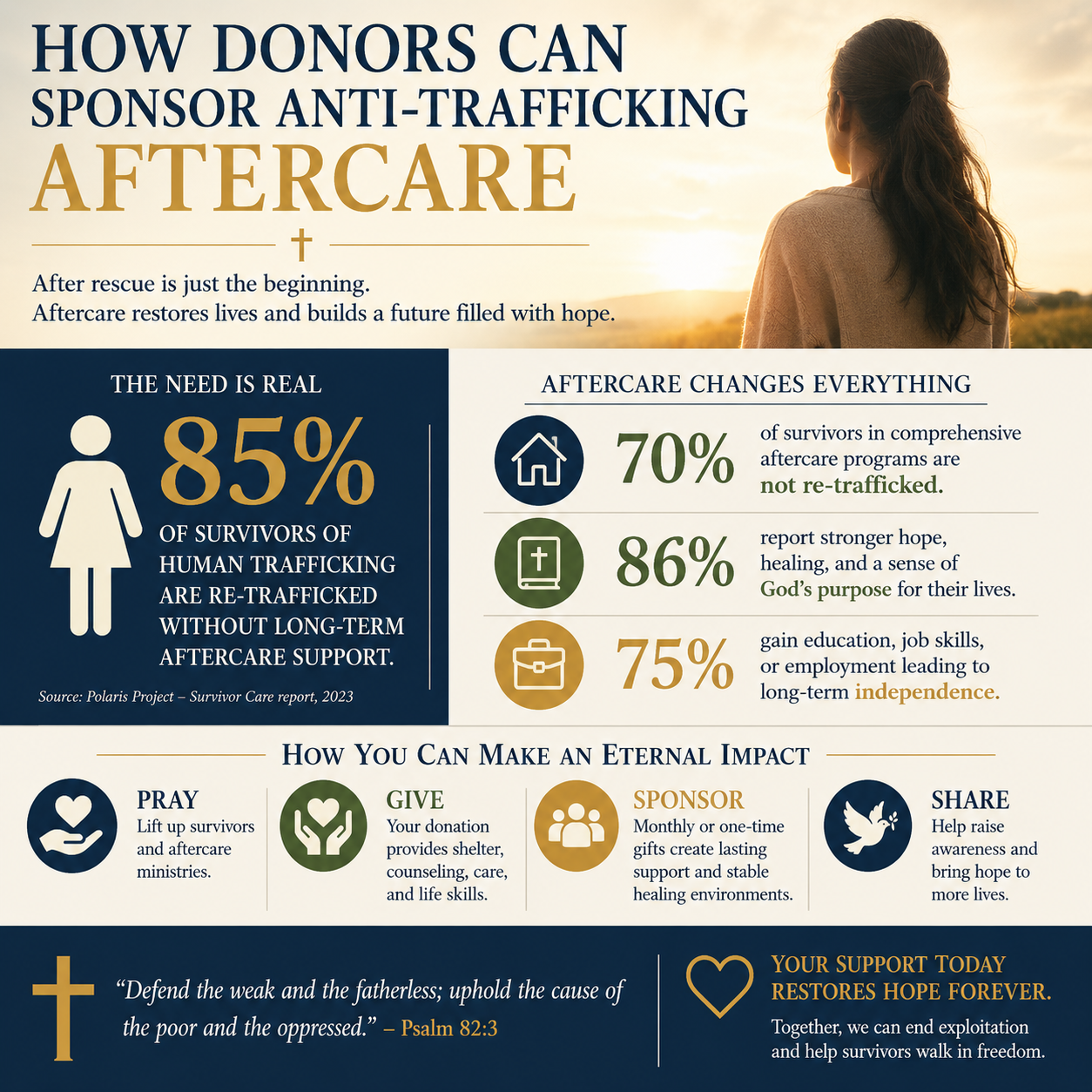
Sponsoring anti-trafficking aftercare is one of the most consequential choices a Christian donor can make, because aftercare is where rescue narratives meet the long, costly work of restoration. Many donors understandably want to fund the decisive moment of liberation. Yet Scripture’s vision of mercy is patient, embodied, and committed to the wounded neighbor over time, not only at the roadside but also in the inn (Luke 10:34–35).
Aftercare is also where harm can be done unintentionally. The field has learned that poorly governed programs can retraumatize survivors, mishandle confidential data, or overpromise outcomes that cannot be responsibly delivered. Christian donors are right to ask not only whether a ministry is sincere, but whether it is competent, accountable, and safe for the people it serves.
1. Define what aftercare must accomplish
Aftercare is not an event but a continuum
Anti-trafficking aftercare typically spans crisis stabilization, safe housing, trauma therapy, medical care, legal advocacy, education or job placement, and long-term community reintegration. The timing varies by survivor and context. Some need days of stabilization before a safe family reunification; others require months or years of structured support, especially when trafficking has been prolonged or began in childhood.
Verifiable evidence suggests that forced labor and sex trafficking intersect with multiple systems—migration, foster care, homelessness, domestic violence, and online exploitation—so aftercare cannot be reduced to a single service. What this means in practice is that donors should expect coordinated care plans and partnerships, not a ministry attempting to do everything in isolation.
The scope should match the reality of trafficking
Trafficking is frequently misunderstood as primarily international kidnapping. Many cases are domestic, involve coercion by someone known to the victim, and include complex trauma and legal vulnerability. A careful donor posture begins with accurate definitions and credible data. For baseline definitions and typologies used by practitioners, the U.S. State Department’s annual Trafficking in Persons Report remains a central reference point: U.S. Department of State.
The harder question is not whether aftercare is needed, but what kind. Some programs are designed for adults, others for minors. Some work with male survivors, others primarily with females, and many are now adapting to serve survivors across a broader range of identities while maintaining safety and clinical integrity. Christians genuinely disagree about how programs should navigate certain therapeutic frameworks and language. A donor’s task is not to demand ideological uniformity, but to ensure that a ministry’s approach is consistent with its stated faith commitments and does not compromise survivor care.

2. Fund safety and competence before visibility
Clinical oversight and trauma-informed practice are non-negotiable
Aftercare requires more than compassion. It requires specialized training, professional supervision, and clear protocols. Trauma-informed care is not a slogan; it is a disciplined approach to minimizing triggers, restoring agency, and building stable attachment and self-efficacy. Many Christian ministries do this well, integrating spiritual care without coercion and without treating discipleship as a precondition for services.
The World Health Organization has documented the prevalence of mental health symptoms among trafficked persons and the need for appropriate, confidential services, reinforcing why qualified clinical support matters: World Health Organization. Donors should ask whether licensed clinicians are involved directly or through formal referral agreements, and whether staff receive ongoing training and supervision.
Data privacy and survivor consent protect dignity
Survivor stories can move donors, but storytelling can also become a form of exploitation when consent is unclear or when details create risk. Ministries should have written policies governing photography, testimony sharing, and digital security. This is especially critical when survivors may face threats from traffickers, retaliatory abuse, or legal jeopardy.
Across our verification work at Most Trusted, the ministries that meet The Most Trusted Standard tend to treat confidentiality as a governance issue, not merely a communications preference. They can explain who has access to case files, how records are stored, how consent is documented, and what happens when a survivor withdraws permission to share their story.
3. Sponsor the parts donors rarely see
Unrestricted and capacity funding can be ethically superior
Many donors want to “sponsor a bed” or “sponsor therapy sessions.” Sometimes those designations are appropriate and honest. Often, however, the most faithful support is the least glamorous: staff retention, clinical supervision, insurance, transportation, security, legal compliance, and program evaluation. These are not distractions from mission; they are the conditions that make care safe.
Thoughtful philanthropy has increasingly pushed back against simplistic overhead suspicion. The widely cited “Overhead Myth” letter—signed by major nonprofit evaluators—argues that administrative capacity is essential to effectiveness and should not be treated as moral failure: Charity Navigator.
Consider a sponsorship model that reflects real costs
Aftercare budgets vary by geography, licensure requirements, and the intensity of services. Instead of demanding a single number that implies artificial precision, donors can sponsor a ministry’s actual cost categories with appropriate flexibility. A responsible ministry will not promise that a fixed gift “fully restores” someone; it will explain how funding supports a care pathway with measurable, limited claims.
When donors evaluate where to give, it is often helpful to understand how anti-trafficking ministries fit within the broader ecosystem of Christian work against exploitation. The directory and research context in Christian Anti-Trafficking Ministries can help donors compare approaches without reducing the issue to marketing narratives.
4. Ask for evidence that respects the complexity of healing
Good metrics are usually modest and well-defined
Aftercare outcomes should be tracked, but the field must resist turning human restoration into a simplistic dashboard. Some outcomes can be measured with integrity: retention in care, housing stability, educational attainment, employment placement, court accompaniment, or reconnection with safe family. Others, like “freedom,” “healing,” or “discipleship,” require careful qualitative work and must not be used to pressure survivors to perform a testimony.
Government and research bodies consistently note the difficulty of measuring trafficking prevalence and outcomes, which is precisely why donors should prefer ministries that are transparent about limitations and methods. The U.S. Department of Justice’s Office for Victims of Crime provides practitioner-oriented resources that reflect these complexities: Office for Victims of Crime.
What donor due diligence should include
Responsible sponsorship is not only generosity; it is stewardship. Before committing significant support, donors should request documentation and ask direct questions. A short list of signals that often distinguish mature aftercare programs includes:
- Written safeguarding policies, including mandatory reporting and boundaries for staff and volunteers
- Clear clinical partnerships or licensed staff with defined supervision structures
- Board oversight that is active, independent, and literate in risk management
- Transparent financial statements and credible fundraising claims
- Documented survivor consent practices for stories and images
- Outcome reporting that is specific, limited, and not sensational
In our work, The Most Trusted Standard provides donors a way to evaluate ministries across faith commitments, governance, financial integrity, and operational transparency without treating any single metric as a substitute for wisdom. Donors are not trying to eliminate risk—aftercare is inherently high-stakes—but to ensure that risk is managed for the survivor’s protection rather than transferred to them.
5. Sponsor with a long horizon and a pastoral theology of care
Christian compassion must be durable
Aftercare exposes a tension Christian donors often feel: the desire to act decisively, and the reality that restoration is slow. Scripture commends both zeal and endurance. The fruit of the Spirit includes patience, and the New Testament repeatedly frames love as costly perseverance rather than momentary intensity (Galatians 5:22–23). Sponsors who stay engaged over years, not weeks, often provide the stability that programs require to retain qualified staff and keep survivors safe.
Durable sponsorship may also mean funding “less urgent” needs: staff sabbaticals, training in evidence-based modalities, facility maintenance, and legal compliance. These are not secondary concerns; they are ways of honoring the image of God in survivors by refusing to offer them improvised care.
Partner with ministries that understand the limits of their role
Some of the most trustworthy aftercare programs are notably careful about what they will not do. They do not run amateur investigations. They do not stage rescues for cameras. They do not place untrained volunteers in roles that require clinical skill. They cooperate with law enforcement where appropriate while maintaining survivor agency and confidentiality.
Many donors also want to ensure their giving reflects a broader theology of justice and mercy. Within How to Give Wisely to Christian Anti-Trafficking Ministries, donors can compare models of intervention—prevention, aftercare, policy, and economic empowerment—while maintaining clarity about what aftercare uniquely requires.
FAQs for How donors can sponsor anti-trafficking aftercare
Should donors sponsor rescue operations or aftercare programs?
Many Christian donors rightly feel urgency about immediate liberation, but aftercare is where survivor safety, long-term stability, and genuine restoration are most directly at stake. Rescue-oriented work also carries higher operational and legal risks, and donors often lack the visibility to evaluate claims. We generally recommend prioritizing aftercare unless a rescue-focused organization can demonstrate competent governance, lawful operations, and credible partnerships, along with a clear pathway into quality aftercare that does not depend on publicity.
What is the most responsible way to sponsor aftercare without exploiting survivor stories?
Donors can request policies rather than narratives: written consent standards, confidentiality protocols, and safeguards for communications. A trustworthy ministry can describe its approach to donor reporting using aggregate outcomes and anonymized case trends, while refusing to trade survivor privacy for fundraising. Sponsorship that is comfortable funding unglamorous capacity—clinical supervision, staff training, secure facilities, and audited financial practices—often reduces pressure on ministries to monetize trauma.
A sponsorship posture that honors the Gospel
Sponsoring anti-trafficking aftercare is not primarily about funding a dramatic moment; it is about underwriting faithful presence, competent care, and the steady rebuilding of life that trafficking has tried to destroy. Christian donors should demand seriousness—clinically, financially, and spiritually—because survivors deserve more than our sympathy. They deserve ministries whose love is ordered, accountable, and durable, reflecting the character of the God who binds up the brokenhearted and does not abandon the wounded halfway through their healing.



