
How to vet Christian anti-trafficking ministry finances is not a peripheral question for serious Christian donors; it is a test of whether compassion is being joined to wisdom. Scripture does not treat money as morally neutral. Jesus warned that hidden loyalties surface in financial practice, and the apostles required that offerings be handled “honorably not only in the Lord’s sight but also in the sight of man” (2 Corinthians 8:21). In anti-trafficking work, where stories are painful and urgency is real, financial scrutiny is often the difference between funding durable rescue and funding a narrative.
The harder tension is that trafficking is both a real crime and a frequently misunderstood one. Public attention tends to concentrate on dramatic abduction scenarios, while law enforcement and survivor-led organizations often emphasize exploitation that is less cinematic and more entangled with poverty, homelessness, addiction, and coercion. Donors who want to do good can be pulled toward ministries that promise simple outcomes and fast numbers. Financial vetting is one way to resist being governed by emotion instead of stewardship.
Start with verifiable financial reporting, not compelling storytelling
Confirm the organization is legally and financially legible
Before assessing effectiveness, establish whether the ministry’s finances can be responsibly examined. For U.S.-based nonprofits, the baseline is the IRS Form 990 for organizations large enough to file it, audited financial statements when applicable, and a clear legal identity. A ministry asking for major gifts while refusing basic documentation is not exercising the kind of accountability Paul expected when churches collected funds for relief.
When a ministry is small, young, or structured in complex ways (for example, operating programs overseas through affiliates), donors can still ask for legible reporting: board-approved financials, an annual report that reconciles revenues and expenses, and an explanation of how funds move across entities. Complexity is sometimes justified in cross-border work, but complexity also creates cover for self-dealing, related-party transactions, and unmonitored cash handling.
Use public sources to corroborate claims
External validation matters because internal numbers can be curated. For U.S. organizations, an efficient first check is whether the IRS recognizes the entity as tax-exempt and whether required filings exist. Donors can start with the IRS Tax Exempt Organization Search (IRS), then compare what is filed publicly with what is presented in fundraising materials. Discrepancies are not always sinister, but they require an explanation that is specific rather than defensive.
As donors deepen engagement in Christian Anti-Trafficking Ministries, this discipline becomes more important, not less. The more harrowing the mission, the more tempting it is to bypass ordinary accountability as though questions were a lack of faith. In Scripture, faithful giving and careful administration belong together.

Interpret overhead with maturity and focus on financial integrity
Move beyond simplistic overhead ratios
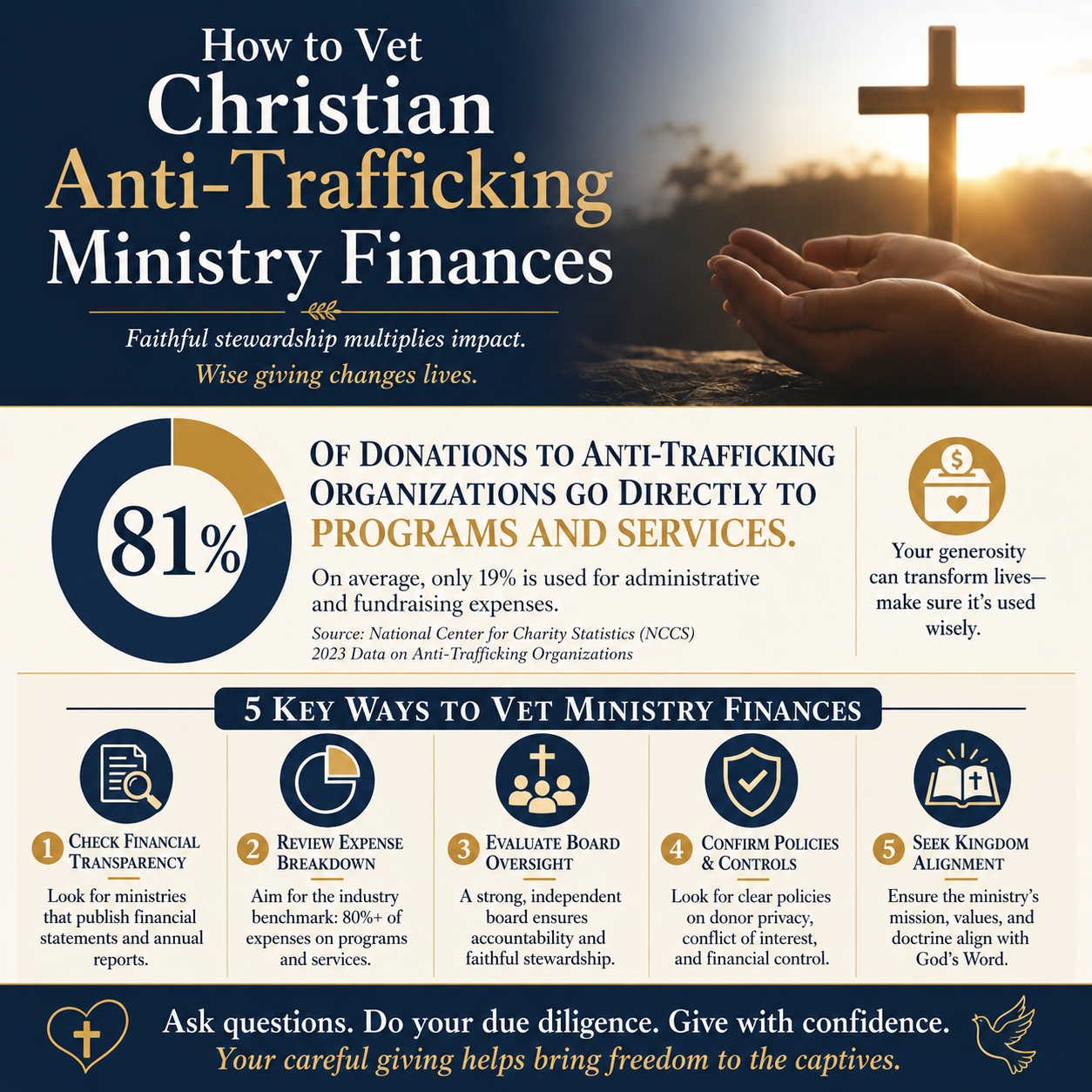
Some donors still assume that the holiest ministry is the one with the lowest “overhead.” That instinct can reward weak internal controls and punish the very systems that prevent harm: qualified finance staff, secure data practices, legal counsel, and trauma-informed training. The nonprofit sector has repeatedly warned that treating overhead as a proxy for virtue is misleading, including in the joint “Overhead Myth” letter signed by GuideStar, BBB Wise Giving Alliance, and Charity Navigator (Candid).
The question is not whether a ministry spends on administration; it is whether spending patterns match a coherent strategy and whether controls are strong enough to keep vulnerable people safe and donor funds honest. A finance function that cannot produce timely, accurate reports is not a neutral weakness in anti-trafficking work. It increases the risk of uncontrolled cash, undocumented assistance, and decisions driven by fundraising pressure.
Look for indicators of healthy financial controls
Across our verification work at Most Trusted, the ministries that meet The Most Trusted Standard typically show financial integrity in ordinary, checkable ways: separation of duties, board review of budgets, documented expense policies, and credible external review when the size of the organization warrants it. Donors do not need to become forensic accountants to ask for these basics.

- Board-approved annual budget and regular variance reporting
- Written policies for travel, per diem, and cash assistance
- Clear documentation for restricted gifts and how they are tracked
- Disclosure of related-party transactions and conflict-of-interest policy
- Independent audit or review when revenues and complexity justify it
Financial controls are not merely administrative; they are pastoral in effect. Survivors and at-risk communities experience instability constantly. Ministries that handle money carelessly tend to handle people carelessly as well, even when intentions are sincere.
Follow the money to the field and ask what the funds actually buy
Distinguish between awareness work and direct services
Anti-trafficking ministries often combine prevention education, awareness campaigns, survivor care, legal advocacy, and partnerships with law enforcement. These approaches are not equally costly, and they do not produce the same type of outcomes. Donors should ask for a program map that connects dollars to activities to measurable outputs. “Raising awareness” can be legitimate, but it can also become a fundraising engine that consumes resources without clear evidence of risk reduction.
Christians genuinely disagree about the best mix of strategies. Some prioritize aftercare and long-term housing; others invest in community-based prevention; others support prosecution and policy. Financial vetting does not require donors to settle the debate in the abstract. It requires donors to ensure a ministry is honest about what it funds and disciplined about how it measures progress.
Assess international pass-through and partner accountability
When donations are sent overseas, the main financial question becomes partner oversight. How are funds transferred, documented, and monitored? What due diligence is done on local partners? What proportion of funds are pass-through grants versus direct ministry operations? There is no universal “right” answer, but there are wrong answers, especially when a U.S. nonprofit cannot produce grant agreements, reporting expectations, and evidence of follow-up visits or audits.
Donors should also ask whether the ministry’s approach aligns with established safeguards in humanitarian work: protecting identities, limiting photography, and avoiding public storytelling that puts survivors at risk. A ministry can be financially “efficient” while creating downstream harm by rewarding sensational content. That is not faithful stewardship; it is extracting value from suffering.
Evaluate governance and incentives that can distort financial decisions
Scrutinize board independence and executive compensation
Financial integrity is ultimately a governance issue. A weak board, a founder with unchecked authority, or a culture that treats questioning as disloyalty will eventually show up in money decisions. Donors should ask who sits on the board, how conflicts of interest are handled, and whether the board reviews executive compensation using comparable data and documented deliberation.
Compensation in Christian ministry is a sensitive subject because the work is vocational, and because some donors assume low pay is a mark of sincerity. Scripture is clearer than many donor instincts: “the laborer deserves his wages” (1 Timothy 5:18). The question is not whether leaders are paid; it is whether compensation is set transparently and governed responsibly, without related-party enrichment or opaque benefits.
Watch for fundraising models that pressure the numbers
Anti-trafficking fundraising can be distorted by the demand for dramatic results: “rescues,” “raids,” “girls saved,” and other metrics that are rhetorically powerful but operationally ambiguous. Donors should ask a simple question: what does the ministry count, and who verifies it? The U.S. State Department’s annual Trafficking in Persons Report repeatedly emphasizes the need for accurate definitions and credible data in counter-trafficking efforts (U.S. Department of State). Inflated claims may raise more money in the short term, but they corrode trust and can push partners toward ethically fraught practices.
Governance should also address data ethics. If a ministry’s “outcomes” are built on unverifiable stories, or if “confidentiality” is used to avoid any outside accountability, donors should treat that as a governance failure, not merely a communications preference.
Ask for transparency that respects survivors and strengthens trust
Expect clarity about results and limitations
Transparency in anti-trafficking work has to be more careful than in many other fields. Protecting survivors, respecting legal processes, and avoiding retraumatization impose real limits on what can be shared publicly. Mature transparency does not ignore those limits; it states them clearly and still provides donors with meaningful evidence: audited financials, program descriptions, evaluation methods, and anonymized outcome reporting.
In practice, donors should look for ministries that can articulate what they do not do. If an organization claims to “end trafficking” in a region without discussing labor markets, migration patterns, demand dynamics, or the chronic vulnerabilities that traffickers exploit, the ministry may be promising more than any organization can deliver. A realistic theory of change is not cynicism; it is truth-telling.
Use a consistent standard to compare ministries
Because the field is complex, donors need a stable framework that does not shift with the news cycle. Most Trusted evaluates ministries against The Most Trusted Standard, a 15-criteria framework covering Faith Foundation, Financial Integrity, Governance and Leadership, and Transparency and Effectiveness. The goal is not to reduce Christian giving to a spreadsheet. The goal is to help donors practice discernment with evidence, so generosity is paired with accountability.
For donors exploring Accountability and Transparency in Christian Anti-Trafficking Ministries, the central discipline is consistency: ask the same core questions of every organization, and require comparable documentation. Ministries that welcome those questions tend to be the ones that have already built the internal habits that protect both funds and people.
FAQs for How to vet Christian anti-trafficking ministry finances
Should Christian donors prioritize ministries with the lowest overhead?
No. Low overhead can reflect underinvestment in basic controls, staff training, and compliance systems that are essential in a high-risk field. A more faithful approach is to ask whether administrative spending supports integrity and effectiveness, and whether the ministry can explain its cost structure coherently. Sector leaders have warned against treating overhead ratios as a primary measure of quality (Candid).
What if a ministry says it cannot share financial details because of security and confidentiality?
Security concerns are sometimes legitimate, especially regarding partner identities, survivor information, and operational specifics. But confidentiality should not eliminate financial accountability. Donors can still request audited or reviewed financials, high-level program budgets, board governance documents, and anonymized outcome reporting. When “confidential” becomes a blanket refusal to provide verifiable documentation, the risk to stewardship is substantial.
A disciplined way to give without becoming cynical
Christian donors do not honor God by suspending judgment; we honor him by practicing stewardship shaped by truth. Financial vetting is not a substitute for prayer, nor is it a denial of grace. It is a commitment to handle sacred offerings in a way that is honorable before the Lord and credible before others, so that anti-trafficking work is strengthened rather than destabilized by the generosity meant to sustain it.



