
Knowing how to spot red flags in Christian anti-trafficking ministries is now part of faithful stewardship. The modern anti-trafficking landscape includes courageous frontline work, sincere church support, and also strong incentives for exaggeration, careless storytelling, and strategies that can unintentionally increase harm.
Scripture does not permit naïveté with money or with power. Jesus warned that some will perform public works “to be seen by others” (Matthew 6), and the apostolic church required integrity in handling gifts designated for the poor (2 Corinthians 8:20–21). Christian donors can be both generous and discerning, insisting on verifiable credibility without losing tenderness toward survivors or cynicism toward the field.
1. Start with the ministry model not the marketing
Most donor-facing anti-trafficking messaging is designed to move the heart quickly: rescue narratives, dramatic statistics, and urgent calls to act. The harder question is what the ministry actually does day to day and whether that work reflects competent practice, lawful cooperation, and survivor-centered ethics.
Clarify whether it is prevention, identification, aftercare, or advocacy
Trafficking is not one problem with one solution. A ministry may focus on prevention (economic strengthening, safe migration education), identification (training mandated reporters, hotline partnerships), aftercare (long-term residential and clinical services), or advocacy (policy and systems change). A frequent red flag is when a ministry’s claims span all of the above while its staff capacity and partnerships are thin. Mature organizations name their lane plainly and can explain why they chose it.
Watch for “rescue” language that crowds out lawful coordination
Christians genuinely disagree about the best way to describe intervention. Yet practically, any direct engagement with trafficking situations intersects with law enforcement, child welfare, immigration law, and clinical standards of care. When a ministry presents unsanctioned “operations” as its core identity and offers few specifics about legal authority, referral pathways, or safeguarding, donors should pause. Competent work is usually less cinematic and more procedural: documented intake, informed consent, case plans, and careful cooperation with local authorities and vetted service providers.

2. Demand clarity on outcomes that can be verified
Trafficking work is difficult to measure, and simplistic metrics can do damage. Yet the inability to measure perfectly is not a license to measure nothing. Ministries worthy of trust can articulate what success means, what data they track, and what limitations their data carries.
Be cautious with inflated numbers and vague categories
One common red flag is a very large “rescued” or “freed” number without definitions. How does the ministry define a trafficking victim? What counts as a “rescue”? Does the count include people reached through awareness events, hotline cards distributed, or social media impressions? Donors are not dishonoring the work by asking for definitions; we are protecting it from distortion.
Another red flag is a ministry that treats awareness as the primary measurable output while implying it is direct anti-trafficking intervention. Awareness has a place, but it is not a substitute for properly funded care, prevention, and coordinated reporting.
Use the field’s own caution about statistics as a filter
Anti-trafficking statistics are often repeated in ways that exceed what research can responsibly support. The U.S. Government Accountability Office has documented limitations in available trafficking data, including inconsistent definitions and challenges in estimating prevalence, which makes sweeping claims especially suspect U.S. Government Accountability Office. A trustworthy ministry communicates with that restraint: careful claims, transparent methods, and humility about what cannot be known with precision.
3. Examine survivor care ethics and safeguarding as core credibility
A ministry may have orthodox theology and sincere zeal, but still practice care that is clinically naïve or ethically unsafe. Trauma does not yield to enthusiasm. The ministry’s safeguarding posture—how it protects survivors, minors, and vulnerable adults—should be as visible as its fundraising appeal.
Privacy, consent, and storytelling should be nonnegotiable
If a ministry regularly uses identifiable survivor stories, photos, or details that could retraumatize or endanger, the donor is seeing an ethical warning sign. Responsible organizations can tell the truth about evil without turning a survivor into a fundraising asset. Consent should be informed, revocable, and never pressured by dependency. The donors who fund the work should want nothing that a survivor might later regret under calmer conditions.
Verify professional competence and referral discipline
Aftercare is often long-term and clinically complex, involving substance use treatment, trauma-informed therapy, medical care, legal advocacy, and stable housing. When a ministry claims to provide “restoration” without qualified clinical leadership, documented safeguarding policies, and clear referral partnerships, the risk of harm rises. Donors should expect to see staff qualifications, background check practices, policies for working with minors, and explicit boundaries around counseling, deliverance ministry, and spiritual direction.
Across our verification work at Most Trusted, the organizations that meet The Most Trusted Standard tend to show their safeguarding posture in writing, not merely in sentiment: board-approved policies, staff training, incident reporting procedures, and survivor-centered communications that treat confidentiality as part of loving one’s neighbor.
4. Follow the money and the governance
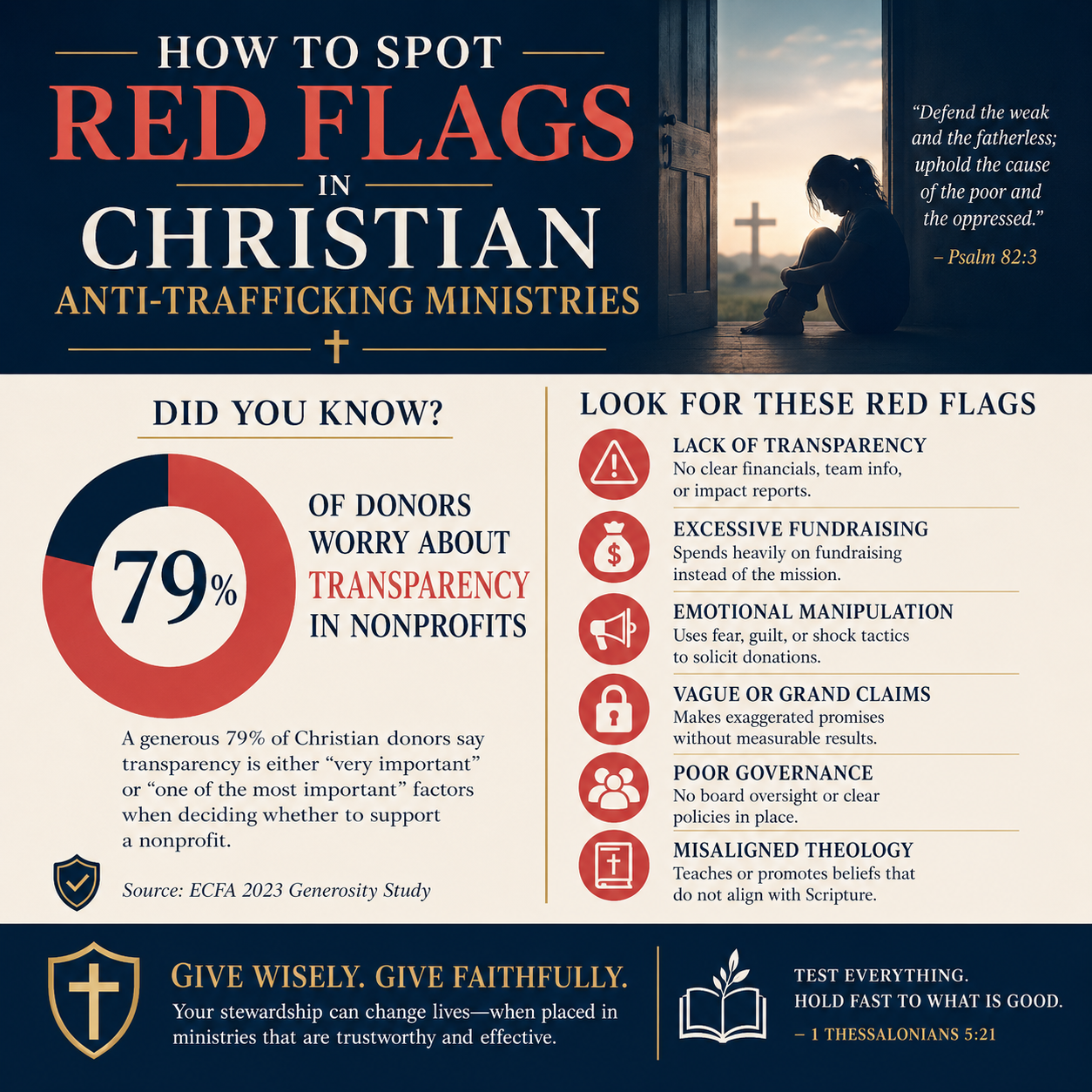
Trafficking is a cause that reliably attracts donor emotion, and that creates temptations. Financial transparency and governance are not secondary issues; they are among the main ways a donor tests whether compassion is being stewarded with sobriety.
Identify patterns of dependency on dramatic fundraising
Some ministries are locked into a “crisis marketing” model that requires constant sensational claims to keep revenue flowing. When communications repeatedly promise urgent rescues, deadlines, or secret operations, ask whether the organization is building a fundraising machine rather than durable capacity. A mature ministry can raise funds with urgency while still speaking accurately and allowing donors to see normal operating realities: staff costs, training, rent, clinical supervision, compliance, and evaluation.
Look for accountable boards and credible financial reporting
For U.S.-based charities, public filings matter. A pattern of missing or inconsistent IRS Form 990 filings, unusually high related-party transactions, or a board composed mainly of insiders and family members should prompt further questions. The IRS makes clear that most tax-exempt organizations must file annual information returns, and these filings are part of public accountability Internal Revenue Service. A ministry does not need to be large to be transparent; it needs to be governed.
Financial ratios alone do not prove virtue or vice, and Christians should resist the simplistic idea that “low overhead” is automatically holy. The field has learned this lesson repeatedly, and major nonprofit evaluators have warned against using overhead as a proxy for impact Charity Navigator. The more reliable question is whether spending aligns with mission, whether financial controls are credible, and whether leadership is accountable to independent oversight.
5. Use a disciplined discernment process before you give
Donors often feel a moral pressure to give quickly once they are convinced the cause is urgent. The gospel forms a different posture: generosity joined to wisdom. The book of Proverbs treats prudence as a moral good, not a lack of compassion. The goal is not to “catch” ministries; it is to fund work that is truthful, lawful, and genuinely helpful to survivors.
A short list of questions that surfaces red flags
- Can the ministry describe its specific model and referral pathways without relying on secrecy or sensationalism?
- Are outcomes defined in plain language, with clear boundaries on what is and is not being counted?
- Are survivor privacy and informed consent visible in communications and policy, not merely assumed?
- Does the ministry show evidence of qualified care, clinical supervision, and safeguarding training?
- Are finances and governance transparent enough for a prudent donor to evaluate stewardship?
Where Most Trusted fits
Many donors do not have the time or specialized knowledge to assess safeguarding, governance, and reporting across a complex field. Most Trusted exists to serve that gap. We evaluate Christian nonprofits against The Most Trusted Standard, a 15-criteria framework spanning faith foundation, financial integrity, governance and leadership, and transparency and effectiveness. What this means in practice is that donors can seek evidence of maturity without expecting perfection, and can identify patterns that commonly correlate with harm.
For donors who want broader context on the sector, our coverage of Christian Anti-Trafficking Ministries tracks the major models, recurring debates, and accountability lessons that have emerged as the field has matured.
Accountability is not suspicion baptized in religious language. It is love of neighbor applied to systems: protecting survivors from exploitation, protecting donors from manipulation, and protecting faithful ministries from the reputational damage created by careless peers. Donors who give with discernment strengthen the work that deserves to endure.
FAQs for How to spot red flags in Christian anti-trafficking ministries
Should Christian donors avoid ministries that talk about rescue?
Not necessarily. The concern is not the word itself but the presence or absence of lawful coordination, clear definitions, and survivor-centered practice. When “rescue” is used as a marketing identity without transparent partnerships, policies, or credible referral pathways, it often signals risk. When it is used carefully within a documented model of cooperation and care, it may simply be shorthand for legitimate intervention.
What is the single most reliable sign of trustworthiness?
There is no single indicator that replaces careful review, but consistent transparency is among the most predictive signals. Ministries that willingly provide clear model descriptions, safeguarding policies, measurable outcomes with definitions, and credible financial and governance documentation usually have fewer hidden liabilities. Our work in Accountability and Transparency in Christian Anti-Trafficking Ministries reflects that pattern across organizations of very different sizes and approaches.
Stewardship that honors both truth and mercy
Trafficking is real, and the suffering involved is grave. Christian donors should not respond by turning away, nor by funding the loudest story. The faithful path is generous support grounded in truth, disciplined oversight, and a sober commitment to do good without doing harm. When donors insist on verifiable integrity, we honor survivors as neighbors rather than narratives, and we strengthen ministries whose work can bear the weight of trust.



